Search This Blog

Monday, 6 January 2014

Earning A Living


The final part of my 'Earning a Living' series, which looks at ancestors' occupations which crop up in the censuses,in Discover Your History magazine, this month discusses undertakers, valets, the woollen trade, xylography, X-ray technicians, yarn dealers, yeomen and zinc workers.  


The woollen trade was an important employer in south- west England and Yorkshire for centuries. In 1818 one pack of wool, if made into stockings, gave work for a week to 184 people: 10 combers, 102 spinners, winders, etc. and 60 stocking-weavers, plus doublers, throwers, and a dyer.  


Xylography is the art of cutting a picture onto a wooden block in order to produce a printed engraving or wood-cut and a skilled xylographer could copy a drawing in reverse directly onto the wooden block.  Hans Holbein (c.1497–1543) and Albrecht Dürer were famous for their beautiful woodcuts and in the late eighteenth century, Thomas Bewick’s wonderful illustrations sparked a revival of this ages-old art. 
 
Although zinc ores are found in several English counties including Cumbria, Cornwall, Devon, Derbyshire and Flintshire, in the early 1860s, less than 3,000 tons of zinc were mined in the UK annually.   

Zinc was cheaper than tin for making metal alloys like brass, but it's a tricky metal to extract from its ores because it quickly boils off as vapour at the temperatures used for smelting metal ores like iron, and several different techniques were used. William Champion’s zinc processing plant at Bristol in 1738 used the ‘English’ method. 


Images from author's collection:

Coloured Cloth Hall, Leeds, 1860s. Hundreds of clothiers sold dyed woollen cloth here. Pictorial Gallery of Arts Vol. I, (c. 1860).

Abbey Mills, Bradford –on-Avon.  Cloth mill built c.1875; later a rubber factory. © Sue Wilkes.  

‘Death the Avenger’, a reduced version of a woodcut by Albert Rethel (1816–1859). Good Words, Isbister & Co., 1893.


Sunday, 22 December 2013

Merry Christmas!

Merry Christmas everyone! I hope you all have a lovely Christmas and peaceful New Year.

Image: Engraving of an ancient sculpture unearthed in Hampshire: The Offering of the Magi, Gentleman's Magazine,|January, 1824.

Tuesday, 3 December 2013

Regency Cheshire Talk - More Photos


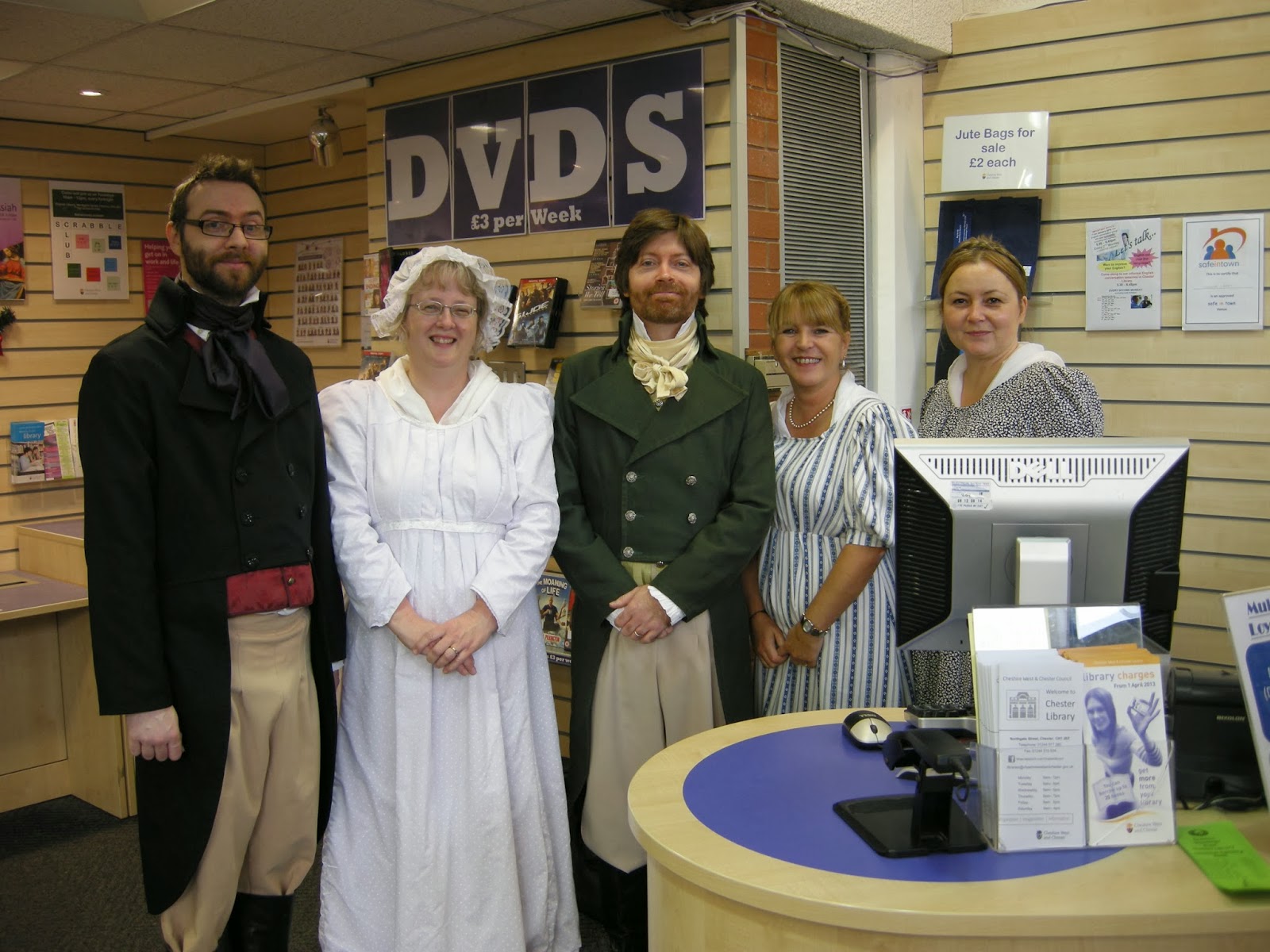
I had a wonderful time at my Regency Cheshire talk on Saturday - a big 'thank you' to Lena Shiell and all the library staff who worked so hard to make the Jane Austen Christmas event so special.  Sadly the traffic was so bad that I only got a glimpse of the Regency dancers, but I did hear the choir singing beautifully.

You can see more photos from the day on my Jane Austen blog and on the Chester Library facebook page.


Images:
Chester Library staff and David Mitchell, the Chester town crier at the Jane Austen's Regency Christmas day (3 photos).
Sioned Webb, Welsh Triple Harpist.
The author preparing to give her talk.
All photos on this blog post are © Lena Shiell of Chester Library.


Wednesday, 27 November 2013

Schools and School Registers

My latest feature for Who Do You Think You Are? magazine focuses on school registers, which are a wonderful resource for tracing your ancestors' childhood. Until fairly recent times, parents paid for their children’s education.  Admission registers were essential so that schools could check how many children attended, their parents’ contact details, and whether school fees were up-to-date. 

Upper class children, and middle class children whose parents were well-off, were usually taught by tutors or governesses at home during their early years.  When they were about ten years old, boys went to schools like Eton and Harrow to prepare them for university. Girls like Jane Austen and her sister Cassandra were sent to a ‘honest, old-fashioned boarding school… where girls might be sent to …scramble themselves into a little education without any danger of coming back prodigies’ (Jane Austen, Emma, 1815).  Most boarding schools taught a smattering of ‘ladylike’ accomplishments rather than a good, all-round education.  Alternatively girls attended a local day school or a seminary if affordable.

Working class children (if their parents were prepared to pay for their education) attended ordinary day schools for a few pence per week, unless they obtained a charity (‘Blue Coat’) school place or a free scholarship. Thousands of poor children had no education at all, or perhaps just went to Sunday school.
Middle-class parents in straitened circumstances who did not want their children to mix with working-class children at ordinary day schools, tried to get them a place at a charity school where education was free or subsidized.

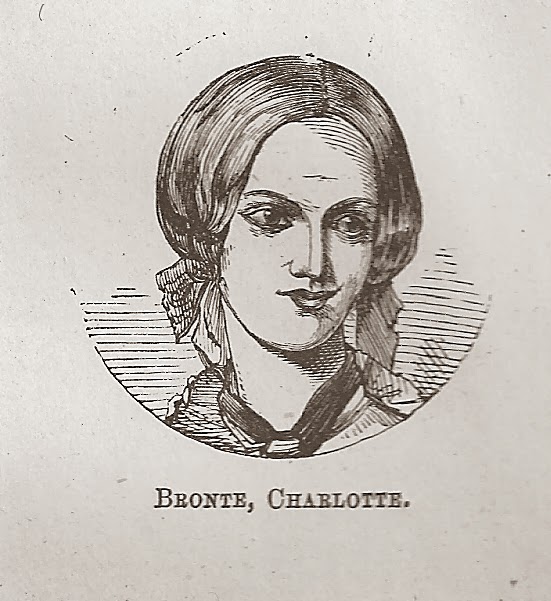
The Revd. Patrick Brontë (1777–1861) had a very limited income. He sent his four eldest daughters, Maria, Elizabeth, Charlotte and Emily to the Clergy Daughters’ School, Cowan Bridge after their mother Maria’s tragic death.  The fees for this school were subsidized by a charity.  The school’s regime was spartan, with poor quality food, and the two older Brontë sisters, Maria and Elizabeth, whose health was not robust, died in 1825. Charlotte later immortalized her experiences in Jane Eyre (1847). 

Some public and grammar school registers are available in large reference libraries, and free on Google Books and the Internet Archive.

Images:
A class of school girls with their teacher, postcard circa 1910.
Charlotte Brontë.
Plaque marking the location of the Oliver Whitby (Blue Coat School), Chichester.  © Sue Wilkes.


Thursday, 21 November 2013

Kindertransport Live

A new play looking at the experiences of child evacuees during WWII is being performed at theatres and railway stations across the UK.  The Kindertransport was a mission to help rescue children fleeing Nazi-occupied Europe.  You can find out more about the play and the history behind the play's story here; tour dates are here.

If your ancestor was a child evacuee in England and Wales, my new book Tracing Your Ancestors' Childhood includes sources for evacuees.

Thursday, 7 November 2013

Chester Library Talk: Regency Cheshire

Just a reminder that I'll be giving a talk at Chester Library on 30 November from 2-3pm as part of the library's 'Jane Austen's Regency Christmas' fun day. I'll be reading extracts from my book Regency Cheshire, and I will have some books to sell which you can buy on the day.
However, if you've already bought one of my books (or prefer to buy a copy online first), if you bring it with you, I'll be happy to sign it after the talk.
There are details on how to buy a ticket for the event here.
Image: Eastgate St, Chester, in the 1820s. 


Narrow Windows, Narrow Lives on Kindle!

My book 'Narrow Windows, Narrow Lives: The Industrial Revolution in Lancashire', published by The History Press, is now out on Kindle! 


Photo © Sue Wilkes: 
India Mill, Darwen.