Search This Blog

Showing posts with label schools. Show all posts

Wednesday, 27 November 2013

Schools and School Registers

My latest feature for Who Do You Think You Are? magazine focuses on school registers, which are a wonderful resource for tracing your ancestors' childhood. Until fairly recent times, parents paid for their children’s education.  Admission registers were essential so that schools could check how many children attended, their parents’ contact details, and whether school fees were up-to-date. 

Upper class children, and middle class children whose parents were well-off, were usually taught by tutors or governesses at home during their early years.  When they were about ten years old, boys went to schools like Eton and Harrow to prepare them for university. Girls like Jane Austen and her sister Cassandra were sent to a ‘honest, old-fashioned boarding school… where girls might be sent to …scramble themselves into a little education without any danger of coming back prodigies’ (Jane Austen, Emma, 1815).  Most boarding schools taught a smattering of ‘ladylike’ accomplishments rather than a good, all-round education.  Alternatively girls attended a local day school or a seminary if affordable.

Working class children (if their parents were prepared to pay for their education) attended ordinary day schools for a few pence per week, unless they obtained a charity (‘Blue Coat’) school place or a free scholarship. Thousands of poor children had no education at all, or perhaps just went to Sunday school.
Middle-class parents in straitened circumstances who did not want their children to mix with working-class children at ordinary day schools, tried to get them a place at a charity school where education was free or subsidized.

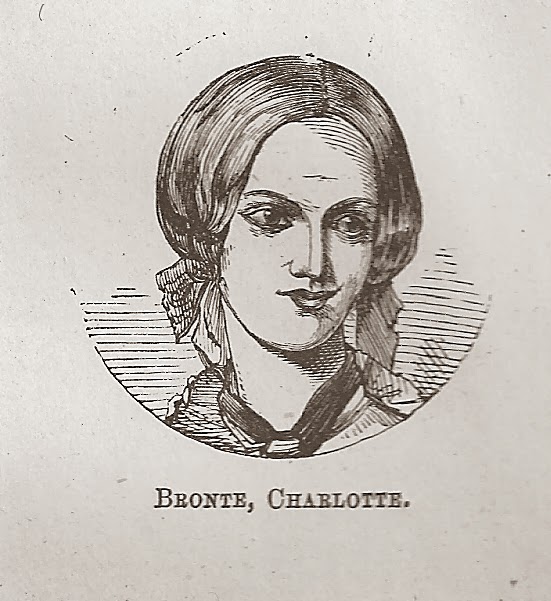
The Revd. Patrick Brontë (1777–1861) had a very limited income. He sent his four eldest daughters, Maria, Elizabeth, Charlotte and Emily to the Clergy Daughters’ School, Cowan Bridge after their mother Maria’s tragic death.  The fees for this school were subsidized by a charity.  The school’s regime was spartan, with poor quality food, and the two older Brontë sisters, Maria and Elizabeth, whose health was not robust, died in 1825. Charlotte later immortalized her experiences in Jane Eyre (1847). 

Some public and grammar school registers are available in large reference libraries, and free on Google Books and the Internet Archive.

Images:
A class of school girls with their teacher, postcard circa 1910.
Charlotte Brontë.
Plaque marking the location of the Oliver Whitby (Blue Coat School), Chichester.  © Sue Wilkes.


Tuesday, 8 October 2013

A-Z of Earning A Living

Eagle-eyed readers of the new Discover Your History magazine (formerly Your Family History) will have spotted my new 5-part series on ancestors' occupations: the A-Z of Earning A Living.  I'm delving into some occupations which crop up in the Victorian censuses. Some trades like baking bread, dyeing cloth and making shoes date back to ancient times.

Guilds like the London Livery Companies were founded during the medieval period, and there's a free online database of apprentices and freemen where you can check for your ancestors' names.  Companies included at present are the Clothworkers, (1545-1908), Drapers (c.1400-1900), and the Mercers (1339-1900), with some data from the Goldsmiths' Company (1600-1700).

Thousands of children worked during Victorian times: they worked as domestic servants, on the land, in coal mines, factories, and in metal manufactures, to name just a few. Many were apprentices, compulsorily bound to a master by the parish authorities.

The age at which your ancestor began work depended on the date; the 1944 Education Act raised the school leaving age to fifteen (an earlier attempt was forestalled by WW2).

In the September issue of Discover Your History, I discussed agricultural labourers, bakers, cotton workers, dockers, dyers and engineers.  My feature in the new October issue explores the world of fishermen, gas workers, haberdashers, half-timers, hawkers, iron workers, jewellers and joiners.  You'll have to buy the magazine to find out more!

Images from the author's collection:
Carpenters and joiners at work. French engraving, c.1820.
Whitby fishermen, Punch, 23 September 1882.
Retorts at a Lancashire Gas Works. Lancashire Industrial & Commercial, 1935.
 

Friday, 27 September 2013

Tracing Your Ancestors' Childhood reviews

 'Sue Wilkes has produced a very detailed book on how to trace your ancestors’ childhood...The book is divided into two parts. The first is in chapters, each dealing with issues that might affect a child’s life; e.g. The Poor Law, Growing up at Work, Education and, very topically, Children in Wartime. This detailed book will help to provide a broad brush picture of life for your ancestors as children in a particular period. The second part of the book is a Research Guide which lists many of those Archives and Repositories. It lists useful addresses, twelve pages of web-sites (some free!), Education Sources and more, under helpful group headings...definitely one for your bookshelf to dip into now and in the future as a reference source'. Ann Gynes, FFHS, December 2013. 

'Over the years, many books have described how children and young people lived in the past. Many others have  shown us technically how to trace the lives of our ancestors of one sort or another.  This book does both, pulling off the now fashionable - and, it must be said, deeply satisfying - meshing of the two genres of social history and genealogy with aplomb.
While Wilkes helpfully begins by recapping on the basic genealogical sources (censuses, certificates and parish records), these soon take an almost subsidiary place among a panoply of other illuminating records from the archives. From cradle rolls and vaccination records, to school exemption certificates, apprenticeship books and records of transportation, 19th and 20th century sources for the study of childhood and youth seem endless...
The eight chapters of part one, themed around different aspects of social history, are vibrantly written, peppered with examples and 'case studies' of real youngsters who grin or grimace briefly at us from the records.
The second half of the book is an unrivalled resource pack for the family historian on the location and accessibility of relevant archives and repositories, as well as list of useful websites, addresses and places to visit...
While child mortality is obviously discussed, the emphasis here is on the way young people of the past survived and triumphed over their varied early experiences, to the point where they grew up and were able to become our ancestors'.  Ruth A. Symes, Who Do You Think You Are?, November 2013.

Monday, 25 June 2012

Stand and Deliver!

Highwaymen or ‘knights of the road’ flourished during the seventeenth and eighteenth centuries. Some of England’s most infamous highwaymen ended their careers on the ‘fatal tree’ at Tyburn long before Jane Austen was born.


Dick Turpin (1705–39), ‘long the terror of the North Road’ (John Timbs, Romance of London, (London, 1865)) was a butcher’s apprentice before turning his hand to stealing game, burglary, murder and highway robbery. Dick was hanged at York in 1739 for horse-stealing.

Highwaymen were still a force to be reckoned with during Austen’s lifetime. In Regency Cheshire, Thomas Brown (twenty-six) and James Price (nineteen) were hanged at Chester for robbing the Warrington mail-coach in May 1796.

You can find out more about the careers of men like the notorious Claude Duval, Turpin, ‘Sixteen-string Jack’, and Jack Sheppard in my latest feature for Jane Austen's Regency World.

By Victorian times, highwaymen and robbers like Turpin, Sheppard and others had become working class heroes because their crimes were perceived as being against the rich and propertied classes, rather than preying on the poor. Their lives became standard fodder for ‘penny dreadfuls’.

During the 1840s, reformers wanted to improve working conditions and access to education for working-class children. Many children could only attend Sunday school as they worked all week, but the education they received there was pretty poor. The 1843 Children’s Employment Commission discovered that some Black Country children had never heard of  British heroes such as Wellington and Nelson, but they had an encyclopaedic knowledge of the lives and careers of Turpin and Sheppard. It was not until the 1870 Education Act that universal education for children was enshrined in law.


Images:

‘An alarm by the guard’. Illustration by Hugh Thomson, Coaching Days and Coaching Ways, (Macmillan & Co. Ltd, 1910).
Heath House, Knutsford, home of highwayman Edward Higgins in the 1750s. Legend has it that Higgins had an escape tunnel under the house. © Sue Wilkes.
Jack Sheppard’s famous escapes from Newgate prison: the obstacles he overcame. Old and New London Vol. II, (Cassell, Petter & Galpin, c. 1878).


Monday, 16 April 2012

Tracing Your Ancestors’ Childhood

I’m thrilled to announce that I’ve just signed a new book contract for Pen & Sword! In Tracing Your Ancestors’ Childhood, I’ll be exploring the history of childhood and education in England and Wales, and discussing relevant records and archives for family historians. I’ll be looking at your ancestors’ childhood experiences at home, school, work, and in institutions such as workhouses for the period from 1750-1950. This handy reference guide will include court records, charities, wartime children, and child emigrants to the USA, Australia and Canada.
I’ll update this blog when more information becomes available about a release date.
Photo: The author growing up in Salford in the 1960s. Author’s collection.


Tuesday, 1 November 2011

The Advent of Sunday Schools

The birth of the Sunday School movement is the subject of my latest feature for Jane Austen's Regency World.

Robert Raikes is often considered the ‘founder’ of Sunday schools for working class children, but there are several candidates for the title. Almost a century earlier, the Revd. Joseph Alleine held classes at Taunton, and there are more instances recorded elsewhere: in Pennsylvania (USA) during the 1740s, at Catterick (Yorkshire) in the 1760s, and at Macclesfield in Cheshire in 1778.
Many of the pin-makers of Gloucester were small children. One day in 1780, Raikes was ‘struck with concern at seeing a groupe [sic] of children, wretchedly ragged, at play in the street’. The children worked all week; Sunday was their only day off. Raikes was worried they would turn to crime unless they were taught right from wrong.
In July 1780, Raikes and the Rev. Thomas Stock, headmaster of Gloucester Cathedral school, set up Sunday schools for the children. This initiative was immensely popular, and spread like wildfire in Britain.
You can find out more about the lives of working children, and their schools, in The Children History Forgot.


Images: Robert Raikes’ house at Gloucester, now a pub.
Memorial statue of Rev. Thomas Charles (1755–1814) at Bala. Charles founded day schools for Welsh children, promoted Sunday Schools in Wales, and was one of the founders of the British and Foreign Bible Society. © Sue Wilkes.

Tuesday, 18 October 2011

Lead Miners’ Children

Compared with coal mining, relatively few children worked underground in the lead mines; most worked at washing and processing the ore, which was done outside in all weathers. Most of the ore washers were boys; only a few teenage girls were employed. They earned 4d a day. They got very cold and wet doing this job.

In the Alston Moor district, the 1842 Report on Mines found that 432 of the 5000 people employed in the area were children and ‘young persons’; only 7 child workers were under thirteen. Only 53 of the ‘bigger boys’ worked underground. In the winter months it got too cold to wash the ore. Boys usually went underground when they were fourteen years old; they earned 9d a day. The miners got ‘asthma’ from breathing in lead dust.
The children of lead miners were often far better educated than those of coal miners. Mining companies such as the London Lead Co. set up schools for the children.
I visited the Killhope Lead Mining Museum a couple of years ago, and went on an underground tour. It was a bitterly cold day, even underground, and it was easy to imagine the hardships which the miners and their children endured.
Images: Killhope Lead Mining Museum’s great waterwheel. The author kitted up ready to explore the mine (I’m more nervous than I look!). The mine entrance.

Photos © Nigel Wilkes.