
My latest feature for Who Do You Think You Are? magazine focuses on school registers, which are a wonderful resource for tracing your ancestors' childhood. Until
fairly recent times, parents paid for their children’s education. Admission
registers were essential so that schools could check how many children attended,
their parents’ contact details, and whether school fees were up-to-date.
Upper class children, and middle class children whose parents were well-off, were usually taught by tutors or governesses at home during their early years. When they were about ten years old, boys went to schools like Eton and Harrow to prepare them for university. Girls like Jane Austen and her sister Cassandra were sent to a ‘honest, old-fashioned boarding school…
where girls might be sent to …scramble themselves into a little education
without any danger of coming back prodigies’ (Jane Austen, Emma, 1815). Most boarding
schools taught a smattering of ‘ladylike’ accomplishments rather than a good,
all-round education. Alternatively girls attended
a local day school or a seminary if affordable.
Working class children (if their parents were prepared to pay for their education) attended ordinary day schools for a few pence per week, unless they
obtained a charity (‘Blue Coat’) school place or a free scholarship. Thousands of poor children had no education at all, or perhaps just went to Sunday school.
 Middle-class
parents in straitened circumstances who did not want their children to mix with
working-class children at ordinary day schools, tried to get them a place at a charity school where education was free
or subsidized.
Middle-class
parents in straitened circumstances who did not want their children to mix with
working-class children at ordinary day schools, tried to get them a place at a charity school where education was free
or subsidized.
The
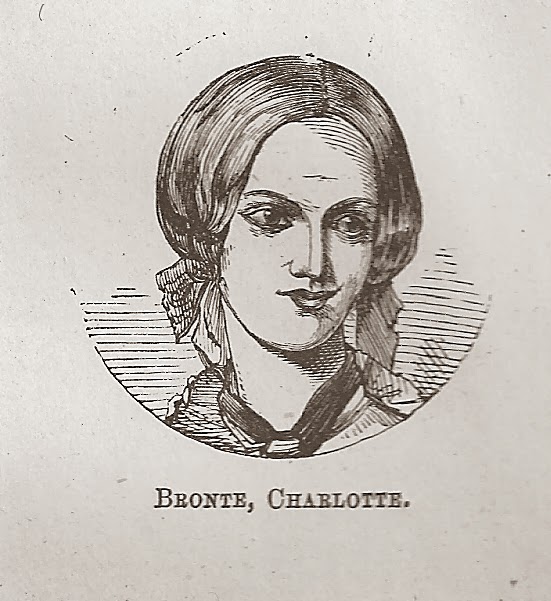
Revd. Patrick Brontë (1777–1861) had a very limited
income. He sent his four eldest daughters, Maria, Elizabeth, Charlotte and Emily to
the Clergy Daughters’ School, Cowan Bridge after
their mother Maria’s tragic death.
The fees for this school were subsidized by a charity. The school’s regime was spartan, with poor
quality food, and the two older Brontë sisters, Maria and Elizabeth, whose health was not robust, died in 1825. Charlotte later immortalized her experiences in Jane Eyre (1847).
Some
public and grammar school registers are available in large reference libraries,
and free on Google Books
and the Internet Archive.

Images:
A class of school girls with their teacher, postcard circa
1910.
Charlotte Brontë.
Plaque marking the location of the Oliver Whitby (Blue Coat
School), Chichester. © Sue Wilkes.


