Search This Blog

Showing posts with label Regency Cheshire. Show all posts

Wednesday, 4 December 2024

Regency Cheshire - Out Now in Paperback!


My book Regency Cheshire has been out of print for some years now - so I'm very pleased to announce that you can now buy it in paperback! It's still available as a Kindle e-book, too. I do hope you enjoy reading it! 


The Temple at Eaton Hall.

Wednesday, 12 December 2018

Peterloo Movie: A Review

I have been fascinated by the tragedy of Peterloo - and its consequences - for as long as I can remember. Next year is the bicentenary of this landmark event for our democracy, which has seemingly never been covered by the movie industry before, so Mike Leigh's new film is very timely. I was not disappointed. 

The action begins four years earlier on the bloody field of Waterloo. Joseph, a young soldier, survives the battle, and begins the long journey home to his family in Manchester. His mum is Nellie (Maxine Peake), who is fighting to keep her loved ones fed during a time of great hardship for the town's workers.

Some of the notable events in the years preceding Peterloo are telescoped with the action in order to provide the necessary historical context. Discontent was growing in the town, which expressed itself in political meetings, and the ill-fated march of the Blanketeers in 1817. Even women had their own societies dedicated to campaigning for parliamentary reform. The speeches of Leigh's characters capture the authentic ring of Manchester's political meetings - and some of the real firebrands of the day - as reported by the authorities' many spies.

Oliver the Spy (Stephen Wight) makes an enjoyable cameo appearance, although actually his identity was compromised in the aftermath of the ill-fated Pentrich Rising two years earlier. 

The meeting at St Peter's Field on 16 August 1819 was organized to hear a speech by Henry 'Orator' Hunt. Rory Kinnear nicely captures Hunt's mixture of bombast and self-importance (and his dedication to reform). Samuel Bamford (played by Neil Bell), who was initially impressed by Hunt, gradually became extremely disenchanted by his attitude. (Surely Bamford is far too well-dressed in the movie? He looks very prosperous).

The main events leading up to the massacre, and the horrifying violence of the day itself, are meticulously covered - right down to the incidents when Hunt helps a fainting woman into his coach, and Hunt is hit on the head by one of Joseph Nadin's thugs after being arrested. A pity that the Cheshire Yeomanry's part in the day was omitted, but perhaps this would have over-complicated the action. 

One seeming inaccuracy which struck me afterwards was the section in the film where Nelly shares out some chunks of bread with another family. Now Nellie's family is depicted as being extremely poor, so they were most unlikely to have been able to afford bread. The Corn Laws (one of the issues which the Peterloo crowd were protesting about) had artificially inflated the price of bread to benefit farmers and landowners. Contemporary accounts of working-class families in this decade in Manchester usually mention that they lived primarily on oatmeal and potatoes. But as gruel and potatoes are not very easy to carry, perhaps the bread was a special treat for the family's 'grand day out'. 

Where this film really hits the nail on the head is Leigh's uncompromising depiction of the enormity of the class divide. The revolting gluttony of the Prince Regent (Tim McInnenry - who was clearly enjoying himself) and the Manchester magistrates' comfortable lifestyle is starkly contrasted with the bare, comfortless homes of the working classes.  

In our age of austerity, and a hopelessly divided Britain, the story of Peterloo has never been more topical. Do go and see the movie. 

Thursday, 1 November 2018

Thomas Harrison, Architect

Chester Castle and Shire Hall complex, 1820s. 
Please saunter over to All Things Georgian, the wonderful blog belonging to my fellow Pen & Sword authors Sarah Murden and Joanne Major. Today they've kindly hosted my guest post on Thomas Harrison, a stunning architect who gave Chester's buildings an air of classical elegance during Regency times

Friday, 27 July 2018

'Liberty Or Death!' Peterloo Is Coming!

A new 'teaser' trailer for Mike Leigh's new film telling the story of the Peterloo Massacre has just been released.
It looks pretty awesome so far! To say I am excited about this movie is an understatement. The release date for the UK is 2 November - I hope it will be available in ordinary cinemas.

Don't forget, the Manchester and Lancashire Family History Society are looking for Peterloo descendants, and my book Tracing Your Manchester and Salford Ancestors has a round-up of Peterloo sources. My book Regency Cheshire, now released on Amazon Kindle, also includes a look at the massacre from the point of view of the Cheshire Yeomanry, who were present at the massacre.


Wednesday, 4 July 2018

Regency Cheshire on Amazon Kindle!

I'm thrilled to announce that my book Regency Cheshire is now available as an e-book on Amazon Kindle!

The late Georgian period was an age of unique style and elegance - the era of Trafalgar and Waterloo. Regency Cheshire explores the scandals, sports and pastimes of the great county families such as the Grosvenors of Eaton Hall. Their glittering lifestyle is contrasted with conditions for humble farmers and factory workers. The gentry and mill owners created elegant new villas and beautiful gardens while workers huddled together in slums with inadequate sanitation.

The Prince Regent and his cronies danced and feasted while cotton and silk workers starved. In my book, I explore the county’s transport system and main industries: silk, cotton, salt and cheese. Stage coaches rattled through the streets, and packet boats and barges sailed down the canals.
Lyme Hall, Cheshire.

But reform and revolution threatened the old social order. Blood was spilt on city streets during election fever and in the struggle for democracy. Balls and bear-baiting; highwaymen and hangings; riots and reform: Regency Cheshire tells the story of everyday life during the age of Beau Brummell, Walter Scott and Jane Austen.

You can read a free sample of Regency Cheshire here!

Tuesday, 23 January 2018

Radio Chat

Crown Hotel, Nantwich. 
I was thrilled to be asked to appear on Redshift Community Radio last week (it's based in the Nantwich area). I really enjoyed chatting to Liz Southall about life in Cheshire in Jane Austen's day, plus tips for tracing your family tree. If you missed it, you can listen the Scarlet Ladies show here on Soundcloud.

Wednesday, 6 May 2015

Nelson and Emma

My latest feature for Jane Austen's Regency World looks at Emma Hamilton's affair with Lord Nelson. You can also find out more about Cheshire-born Emma Hamilton's early career here on my Jane Austen blog.


Image: Lord Nelson, Heroes of the British Navy, Frederick Warne & Co., c. 1900. Nigel Wilkes Collection.

Tuesday, 3 December 2013

Regency Cheshire Talk - More Photos


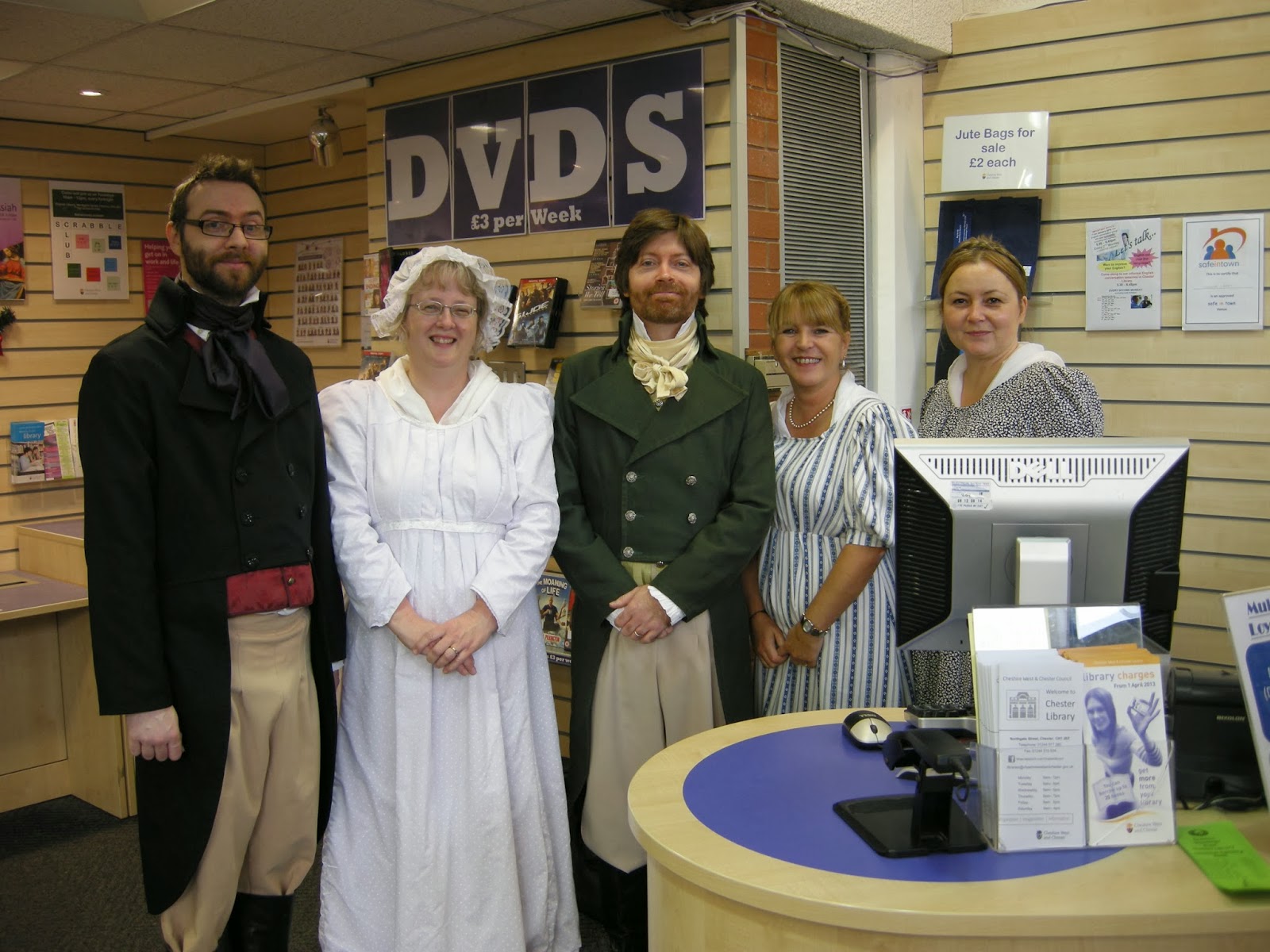
I had a wonderful time at my Regency Cheshire talk on Saturday - a big 'thank you' to Lena Shiell and all the library staff who worked so hard to make the Jane Austen Christmas event so special.  Sadly the traffic was so bad that I only got a glimpse of the Regency dancers, but I did hear the choir singing beautifully.

You can see more photos from the day on my Jane Austen blog and on the Chester Library facebook page.


Images:
Chester Library staff and David Mitchell, the Chester town crier at the Jane Austen's Regency Christmas day (3 photos).
Sioned Webb, Welsh Triple Harpist.
The author preparing to give her talk.
All photos on this blog post are © Lena Shiell of Chester Library.


Thursday, 7 November 2013

Chester Library Talk: Regency Cheshire

Just a reminder that I'll be giving a talk at Chester Library on 30 November from 2-3pm as part of the library's 'Jane Austen's Regency Christmas' fun day. I'll be reading extracts from my book Regency Cheshire, and I will have some books to sell which you can buy on the day.
However, if you've already bought one of my books (or prefer to buy a copy online first), if you bring it with you, I'll be happy to sign it after the talk.
There are details on how to buy a ticket for the event here.
Image: Eastgate St, Chester, in the 1820s. 


Thursday, 18 April 2013

Chester's Bid for City of Culture 2017

Chester has launched its bid to become UK City of Culture in 2017.  You can find out more and show your support for the bid here.


The city is packed with amazing history to explore, such as its Roman amphitheatre and its unique Rows, and I wish it all the best for its bid.
Images: Watergate St, Chester.

Stranger’s Companion in Chester, 4th edition, c. 1828.
Photo:

The Rows on Bridge St. © Sue Wilkes.

Monday, 4 March 2013

Talks in 2013

So far this year I have got two talks lined up, so please make a note in your diaries.  On Thursday 13 June I will be giving a talk on 'Stolen Childhoods'  to Witton Women's Institute at St Wilfred's Parish Centre (Witton Street) in Northwich; the meeting opens at 7.45 pm and my talk begins at 8pm.  I'll be discussing child labour in northwest England during the industrial revolution.

And on Saturday 30 November, Chester Library is holding a Jane Austen's Christmas event.  At 2pm I'll be giving a talk on Christmas time in Austen's day, and will read some extracts from my book Regency Cheshire.  Hope to see you there!


Images:

Mule Spinning Room, 1860s. Child piecers and scavengers at work in a cotton spinning mill, supervised by the overlooker. Charles Knight’s Pictorial Gallery of Arts Vol. I, (c.1862).
Rows in Watergate St, Chester. Stranger’s Companion in Chester, 4th edition, c.1828

Monday, 25 June 2012

Stand and Deliver!

Highwaymen or ‘knights of the road’ flourished during the seventeenth and eighteenth centuries. Some of England’s most infamous highwaymen ended their careers on the ‘fatal tree’ at Tyburn long before Jane Austen was born.


Dick Turpin (1705–39), ‘long the terror of the North Road’ (John Timbs, Romance of London, (London, 1865)) was a butcher’s apprentice before turning his hand to stealing game, burglary, murder and highway robbery. Dick was hanged at York in 1739 for horse-stealing.

Highwaymen were still a force to be reckoned with during Austen’s lifetime. In Regency Cheshire, Thomas Brown (twenty-six) and James Price (nineteen) were hanged at Chester for robbing the Warrington mail-coach in May 1796.

You can find out more about the careers of men like the notorious Claude Duval, Turpin, ‘Sixteen-string Jack’, and Jack Sheppard in my latest feature for Jane Austen's Regency World.

By Victorian times, highwaymen and robbers like Turpin, Sheppard and others had become working class heroes because their crimes were perceived as being against the rich and propertied classes, rather than preying on the poor. Their lives became standard fodder for ‘penny dreadfuls’.

During the 1840s, reformers wanted to improve working conditions and access to education for working-class children. Many children could only attend Sunday school as they worked all week, but the education they received there was pretty poor. The 1843 Children’s Employment Commission discovered that some Black Country children had never heard of  British heroes such as Wellington and Nelson, but they had an encyclopaedic knowledge of the lives and careers of Turpin and Sheppard. It was not until the 1870 Education Act that universal education for children was enshrined in law.


Images:

‘An alarm by the guard’. Illustration by Hugh Thomson, Coaching Days and Coaching Ways, (Macmillan & Co. Ltd, 1910).
Heath House, Knutsford, home of highwayman Edward Higgins in the 1750s. Legend has it that Higgins had an escape tunnel under the house. © Sue Wilkes.
Jack Sheppard’s famous escapes from Newgate prison: the obstacles he overcame. Old and New London Vol. II, (Cassell, Petter & Galpin, c. 1878).


Monday, 5 March 2012

Bringing the Past to Life

Robert Hale Ltd, who publish my books The Children History Forgot and Regency Cheshire, has just launched a new books blog about their authors and newest titles.  You can read my guest blog post about bringing the past to life here.

Monday, 4 July 2011

Travelling Post-haste

If you are a fan of all things Regency like me, you’ll love S4C’s recreation of the days of the Irish mailcoach in their programme ‘Y Goets Fawr’ (The Mail Coach). You can watch a a clip of the show on their website or watch the programme on CLIC here.

Once upon a time, the Irish mails went from London to Holyhead via Chester, but in 1808 the Post Office decided a new, speedier route was needed, via Shrewsbury instead of Chester. Telford’s new road, begun in 1815, meant that coaches could reach an average speed of ten and a half miles per hour. The loss of the Holyhead mail was bad news for Chester businesses, although it remained a busy centre for local coach traffic.
Images: Seeing them off. Illustration by Hugh Thomson, Coaching Days and Coaching Ways, (Macmillan, 1910.)
Through the toll-gate. Illustration by Hugh Thomson, Coaching Days and Coaching Ways, (Macmillan, 1910.)


Monday, 20 June 2011

Peckforton in Peril

I was very sorry to hear about the horrific fire at Peckforton Castle yesterday. Mercifully, no-one appears to have been hurt, although one wing of the building appears to have been badly damaged. Peckforton was built by Lord Tollemache in the mid-1840s in the Gothic style; it was designed by Anthony Salvin. In Cheshire, the fad for Gothic architecture began in the early 1800s; Cholmondeley Castle was probably the first Gothic mansion, built by George Cholmondeley, the fourth earl, from 1801-4.

By the 1850s the Gothic revival was still going strong, and Peckforton Castle was featured in the Illustrated London News (26 April 1851). A reporter who explored the castle felt that it 'more than rivals Conway for its size and position'. Its apartments were 'splendid' but decorated 'in accordance with the most pure taste and refinement'. I hope Peckforton can be restored to its former glory.
Image: Peckforton Castle, Illustrated London News (26 April 1851). Author's collection.

Thursday, 31 March 2011

More Narrowboat Fun

It was lovely to see Macclesfield's silk museums featured on BBC1's The Boat That Guy Built last night. I was very interested to watch this episode as I explored the story of the silk industry and the growth of Cheshire's canal network in Regency Cheshire.

While Guy has brought Britain's industrial past to life each week while restoring his narrowboat, one aspect of life I don't think he's mentioned is that child workers were used in many of the trades and industries he's explored. Children were used as cheap labour in the silk and cotton industries, and metal industries, and you'll be able to read more about their stories in The Children History Forgot when it's launched later this year.
Image: Macclesfield, early 1900s. Etching by Roger Oldham (1871-1916) for Picturesque Cheshire (Sherratt & Hughes, 1903.)