Search This Blog

Showing posts with label Industrial Revolution. Show all posts

Saturday, 11 July 2026

Jacquard's Invention


My latest feature in my industrial revolution series for Jane Austen's Regency World magazine is on M. Jacquard's loom. 'Figured' fabrics were decorated with intricate patterns. Since ancient times, a draw-loom or draw-boy loom was used for weaving figured damasks. 

Some versions of this loom required a child helper to perch on top of the loom to help the weaver create complex patterns. This was a slow, expensive process, and several inventors simplified the loom to do away with the need for a child helper on top. 

Then early in the nineteenth century, over in France, M. Jacquard's new invention caused a stir.

His loom, which used a combination of punched-cards, hooks and needles, enabled far more intricate patterns to be woven. But the silk workers in his home town of Lyon were violently opposed to his machine, and broke up his loom in the public marketplace. 

Nevertheless, by the late 1820s, the Jacquard loom was used in Britain for weaving furnishing fabrics in silk, worsteds, cotton and wool in a variety of  designs.

Illustration from my collection: Powerlooms stuff manufacture. Jacquard powerlooms are on the left of the picture; looms surmounted by a 'draw-boy' apparatus are on the right.  Pictorial Gallery of Arts. Vol. 1, Useful Arts, The London Printing and Publishing Company, (London, c.1858)

Monday, 9 March 2026

Wickham's 'Blue Coat'


Merino sheep produced short-staple wool suitable for cloth.

My latest feature for the March/April issue of Jane Austen's Regency World is on the increasing mechanization of the woollen industry.

Wool was such a ubiquitous material that 'cloth' was synonymous with woollen fabric. 

 Despite cotton's increasing popularity, woollen cloth was still essential for warmth in Britain's unpredictable climate. Fashionable gentleman like George Wickham in Pride and Prejudice wore blue cloth coats.

A wool-carding machine.
Short-staple (short-fibre) wool was used for cloth, and a fleece required a great deal of cleaning and processing before it could be spun into thread and woven into cloth.

It was primarily the processing of the yarn which moved into the factories during late Georgian times; 'carding', 'scribbling', 'slubbing', and spinning on machines like James Hargreaves' spinning-jenny. 


A slubbing-machine or 'billy'. 


I'll be covering the innovations in the worsted industry in the May/June issue. 

Sunday, 9 November 2025

'Scarlet Sin'


 My latest feature for Jane Austen's Regency World magazine (Nov/Dec issue) is on the ancient craft of dyeing. 

In 1814, Jane Austen wrote to Cassandra to complain about the local dyer: ‘My poor old muslin has never been dyed yet. It has been promised to be done several times. What wicked people dyers are! They begin with dipping their own souls in scarlet sin’.

Dyes were used for many different fabrics: wool, worsted, linen, cotton, and silk. 

The secret of Turkey-Red dyeing (from the Far East), was much sought after in Britain, but it was not until the 1780s that it was successfully accomplished in Britain, in Manchester and the Glasgow area. 

The late eighteenth century also saw the introduction of new dyes from metals, like 'iron buff' and orange from antimony. 

Image from the author's collection: Costume Parisien, Journal des Dames et des Modes, 1803. A ‘Robe de Mousseline Turque’ [Turkey muslin]. 

Tuesday, 25 June 2024

Forging A New Age of Iron

Butterley Iron Works, Derbyshire. 

My latest feature in my Industrial Revolution series for Jane Austen's Regency World (July/August issue) is on the advances made in cast-iron manufacture. In 1775, the year that Jane Austen was born, James Watt’s designs for improved steam-engines first became commercially available.  

Boulton and Watt’s Soho Foundry's steam-engines engines supplied the ‘blast’ for furnaces (instead of bellows); powered forge hammers; and later, powered rolling- and slitting-mills. 

This beach house at Sidmouth (image right) has a cast-iron balcony or 'balconette). 

The genry loved the utility and simplicity of iron. Mr Rushworth’s house in Mansfield Park has a ‘long terrace walk, backed by iron palisades…beyond the bowling-green’.  And a locked iron gate gives Henry Crawford the key to gaining Maria Bertram’s heart. 

Images: 

The Casting-house at Butterley Iron Works, Ripley, Derbyshire. The Pentrich rebels attacked the works in 1817, but were thwarted by its manager. Charles Knight’s Pictorial Gallery of Arts, Vol. 1, London, (c. 1860). Author’s collection. 

Sidmouth photo © Sue Wilkes. 


Thursday, 18 January 2024

A Bright Future

Old-style crown glass shop windows.

My latest feature for Jane Austen's Regency World's January issue, in my series on Austen and the Industrial Revolution, is on glass manufacture. 

When Jane Austen visited her brother Henry in London, she would have seen the new fashion for large, imposing plate-glass shop-windows. 

Plate-glass casting at Ravenhead.

Until the late eighteenth century, plate-glass, used for the largest windows or mirrors, was incredibly expensive. Only the wealthiest could afford it. 

But the advent of plate-glass casting at Ravenhead (the British Plate Glass Co.) in 1773, followed by glass-houses on Tyneside, where there was already a flourishing industry, revolutionised the look of British retail establishments. 

Glass-making in Britain faced a bright future!


Images

A New Bond street shop in the 1790s. Before plate glass became affordable, shop windows were made from small panes of crown glass. James Gillray 1796, courtesy Library of Congress, catalogue number: LC-USZC4-8787.

Casting plate glass at the Ravenhead works in Lancashire in the 1840s. Engraving by Mr Sly. Pictorial History of the County of Lancashire, 1844. Author’s collection.


Tuesday, 9 January 2024

Ready To Pre-Order!


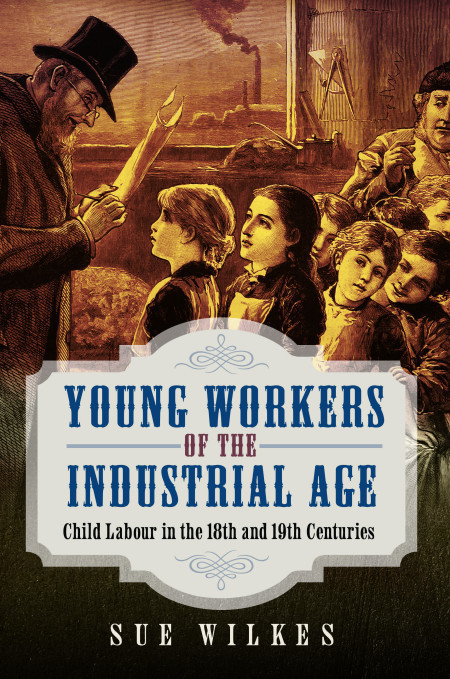
I'm very pleased to say that 'Young Workers of the Industrial Age' is now available to pre-order from Amazon UK! It's currently scheduled for publication in hardback in September this year. 

Tuesday, 13 June 2023

Porcelain and Pots


My series on Jane Austen and the Industrial Revolution is still ongoing, although I haven't had time to update this blog! 

My feature in the March/April issue looked at 'canal mania', and 'Our Wedgwood Ware' is in the current issue of Jane Austen's Regency World

'The Prettiest English China' is coming up in the July/August issue, and looks at the manufacture of English porcelain in places like Worcester, Bristol and London. 


Image: Etruria. Engraving by Henry Warren, G. Greatbach, Staffordshire and Warwickshire Past and Present, Vol. III, William Mackenzie, London, c.1870. 

Friday, 27 January 2023

Muslins and Mule-Spinning

Full dress for December 1798.

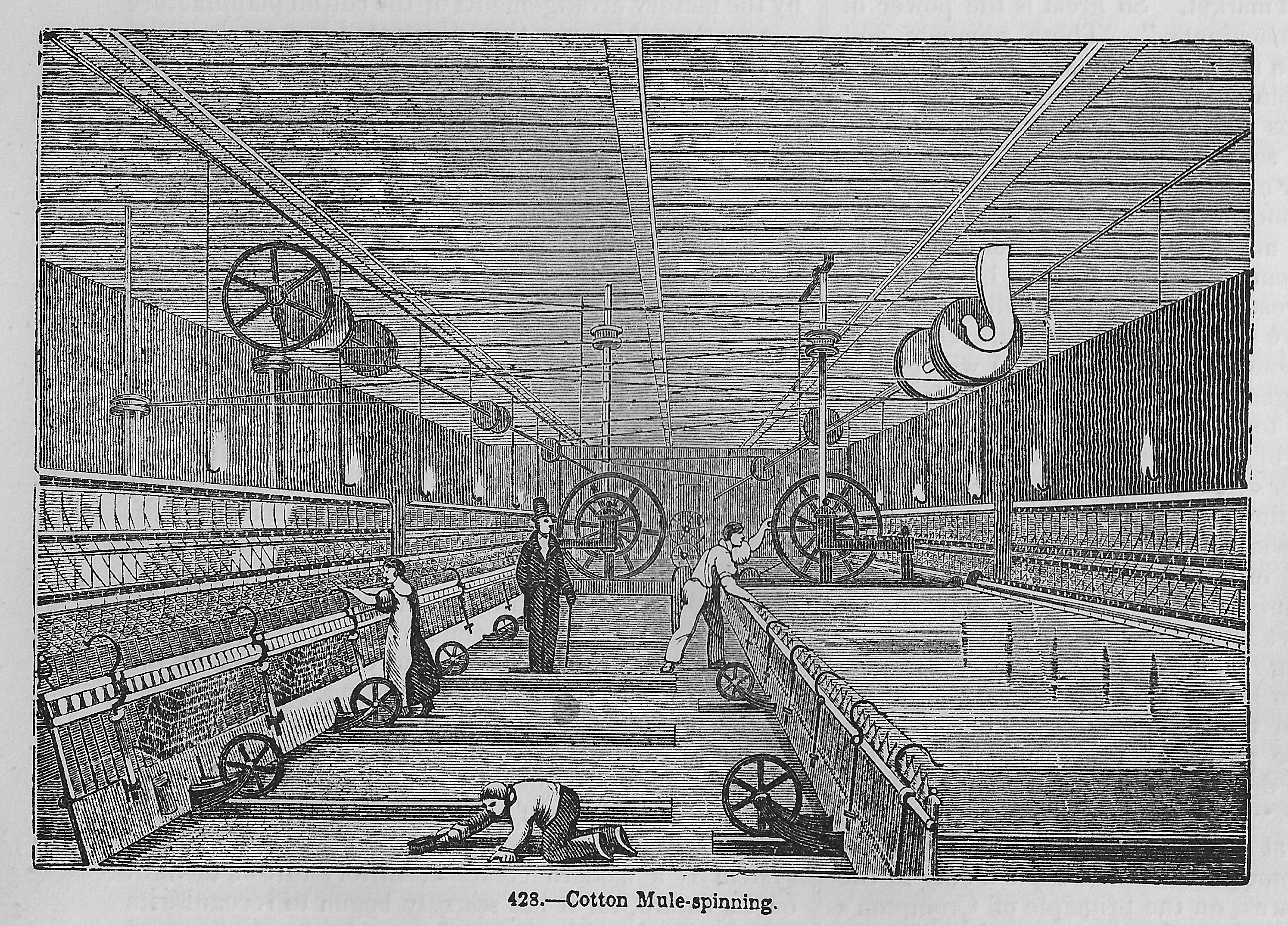
My latest feature for Jane Austen's Regency World (January issue) - on mule-spinning - marks the beginning of my new series on the growing mechanization of Britain's industries during Austen's era. 

The Industrial Revolution affected not just the workers who were the 'shock troops' of the Revolution, but also the way that Jane and her family - and the characters in her novels - lived.  I'm really enjoying writing this series, and I hope that you enjoy it, too! 

Illustrations 
Above:
‘Full dress for December 1798’. The Lady’s Monthly Museum, Vol.1, Vernor & Hood, London, December 1798. Author’s collection. 
Right:
‘Mule’ for spinning cotton. Child workers ‘pieced’ together broken threads, and cleaned cotton waste from under the machine. Charles Knight, Knight’s Pictorial Gallery of Arts, Vol. 1, London Printing and Publishing Co., c.1858. Author’s collection.

Monday, 14 August 2017

The Birth of Cottonopolis


Manchester in the 1740s.
Although Manchester  became synonymous with the cotton industry, in medieval times, it was known for woollens and linens. Tradition has it that Edward II invited skilled Flemish weavers to settle in north-west England during the 1330s. The term Manchester ‘cottons’ was in use as early as the sixteenth century, but these ‘cottons’ were made of wool.

By the early 1640s the area’s textile industries were firmly established. Cotton yarn (imported via Ireland) was woven with linen yarn made from flax to make sturdy ‘fustian’ cloth.
Families like the Chethams, Mosleys and Tippings became very wealthy buying and selling woollen cloths, linens, cotton yarn, and fustians. The wholesalers and master-manufacturers of Manchester became famous.  As these ‘Manchester men’ became richer they built fine homes and large warehouses for their goods.
In the early 1700s pretty, light all-cotton calicoes imported from India and the East threatened to wipe out Britain’s woollen industry. An act of 1721 banned the wearing of, weaving or selling of any printed all-cotton ‘stuffs’ or ‘calicoes’ whether imported or made in Britain. However, ‘fustians’ were exempted, to protect Manchester’s workers.  Woollen and worsted weavers petitioned parliament to ban fustians, too, but the ‘Manchester Act’ of 1736 upheld the exemption. All-cotton printed goods remained banned, however.
Handloom weaving.


During the 1740s, Manchester merchants bought the warps and raw cotton and gave the materials to weavers who worked in their own homes aided by their families. The raw cotton was carded (the fibres were straightened to form a long, fluffy ‘roving’), the rovings were spun into yarn, the yarn was wound onto bobbins, and finally woven into cloth on a loom.

John Kay’s flying shuttle (1733) made hand-weaving easier. Then several key inventions speeded up first the spinning, then weaving of cotton. Lewis Paul and John Wyatt had the idea of thinning out cotton fibre using rollers, and James Hargreaves’s machine, the ‘spinning jenny,’ patented in 1770, revolutionised spinning.
Hargreaves' spinning jenny at North Mill, Belper

Arkwright's water frame at North Mill, Belper.
Preston barber Richard Arkwright built on the work of Lewis Paul and Thomas Highs and created a spinning machine called a ‘water-frame’. Richard Arkwright petitioned parliament to get the ban on all-cotton cloths repealed in 1774. This gave a huge boost to the cotton industry. Then Samuel Crompton’s spinning ‘mule’ (1779) made strong yarn fine enough for weaving all-cotton cloth (calico) and delicate muslin.

Mule spinning room
Mr Gartside’s weaving establishment, opened in 1765, may have been one of the earliest factories in Manchester. (This factory appears to have used an early type of automated ribbon loom, a ‘swivel loom’. Each loom was tended by one weaver). By the 1780s there were two mills in Manchester; Richard Arkwright and partners had one near Angel Meadow, and Mr Thackeray had one at Granby Row.

The big breakthrough for mechanized weaving came when Edmund Cartwright patented a powered loom in 1785. In a future blog post, I’ll look at how steam power affected Manchester during the industrial revolution.

Friday, 23 October 2015

Our Daily Bread

Barony Mills.
The type of bread or grain your ancestors ate depended on which part of Britain they lived in, and which time period. In the middle of the 18th century, many labouring families in the northern counties lived on bread made from barley, or barley and rye.

They also lived on porridge or gruel made from oatmeal, and oat cakes. (Dr Johnson famously defined 'oats' as 'a grain, which in England is generally given to horses, but in Scotland supports the people').
Part of the mill machinery.


Which grain was grown depended on the soil, and the local climate. By the early 19th century, about 3.3 million acres of wheat was grown in England, plus about 2 million acres of barley.


In Cheshire, wheat, oats and potatoes were grown, but very little barley. However in Sussex, wheat, barley, oats, and rye were grown. In East Lothian in the 1790s, wheat, oats and barley were grown.


Whether barley or grain was used to make flour, the basic process of milling it to make flour changed little since very ancient times. The grains were ground between 2 pieces of stone (querns) powered either by hand, wind, or a waterwheel. Roller milling was introduced in the industrial revolution.
The overshot waterwheel.

Last year we enjoyed a tour of Barony Mills, Birsay - the last water-powered beremeal mill on Orkney. The mill was built in 1873, but it's thought that a mill has been on the site since Viking times. Beremeal (pronounced BEARmeal) is used to make bread, biscuits, and bannocks, and
The author setting the big wheel in motion!
very tasty they are too. I was allowed to set the mill machinery going, which was very exciting!

During the Regency era, the price of bread varied hugely owing to several factors - uncertain harvests, the war with France, and (in 1815) the Corn Laws, which artificially raised the price of grain, were introduced to protect the profits of the landowning classes.

When high food prices coincided with a scarcity of work, the government knew that trouble such as food riots were in the offing. The government, and local magistrates relied on spies and informers to let them know if trouble was brewing on the home front, and I'll be discussing what kinds of people were employed as spies in a later blog post..

Thursday, 7 November 2013

Wednesday, 5 June 2013

Save Manchester’s Museum of Science and Industry!


I was horrified to see that the Museum of Science and Industry at Manchester is in danger of closing.  It is reported that the Science Museum Group, of which MOSI is now a member, has a massive operating deficit. It seems that MOSI, the National Railway Museum in York and Bradford's National Media Museum may face the axe in order to keep the Science Museum in London open.


Lancashire was the birthplace of the Industrial Revolution, and Manchester – ‘Cottonopolis’ – was its beating heart.  The first inter-city railway was built here, and the Liverpool and Manchester Railway station is an important part of the MOSI site. Manchester’s contribution to the great scientific breakthroughs of the twentieth century such as computing is well known: MOSI is home to 'Baby', the first stored-programme computer built at Manchester University in 1948.


MOSI is a living showcase of our industrial past, in particular the industrial revolution, with nationally important collections relating to the cotton industry and the city’s social history.   If the collection is closed or dispersed, a wonderful treasure for past and future generations will be lost and is unlikely to be replaced. 


It seems unlikely that the City Council would take over MOSI, as it too faces swingeing cuts from Whitehall and has to prioritise funding for essential services.  But this could be a short-sighted view: I understand from the MEN report that over 830,000 people visited MOSI last year.  Visitors generate income for local businesses, which in turn pay their local rates, and hence more funding for Manchester.  A multiplicity of high quality tourist attractions are vital to help promote the city and attract visitors.

MOSI is not just a collection of machinery – the museum is a window into the past so that we can see how our Lancashire ancestors (including my own) lived and worked in Manchester.  It’s a great resource for local schools, colleges and students as well as tourists. Its closure would be a national disgrace, as well as a local tragedy.  


Although free admission boosts visitor numbers, I would rather pay a modest entrance fee, if this is the only way to keep the museum open.  However, it seems that the Science Museum Group does not have the power to impose entrance fees. 

Please take a moment to sign the MEN petition to save MOSI; there’s also one on Change.org

Update 6 May: The Financial Times is running the story this morning, and the MEN petition has already received over 20,000 signatures


Images:

Weaving shed, Haworth’s Mills, Ordsall, Lancashire. Illustration by H E Tidmarsh, Manchester Old and New Vol. II, (Cassell & Co., c. 1894).


Drawing cotton at Richard Howarth & Co., Tatton Mills, Ordsall, early C. 20th postcard.

Monday, 4 March 2013

Talks in 2013

So far this year I have got two talks lined up, so please make a note in your diaries.  On Thursday 13 June I will be giving a talk on 'Stolen Childhoods'  to Witton Women's Institute at St Wilfred's Parish Centre (Witton Street) in Northwich; the meeting opens at 7.45 pm and my talk begins at 8pm.  I'll be discussing child labour in northwest England during the industrial revolution.

And on Saturday 30 November, Chester Library is holding a Jane Austen's Christmas event.  At 2pm I'll be giving a talk on Christmas time in Austen's day, and will read some extracts from my book Regency Cheshire.  Hope to see you there!


Images:

Mule Spinning Room, 1860s. Child piecers and scavengers at work in a cotton spinning mill, supervised by the overlooker. Charles Knight’s Pictorial Gallery of Arts Vol. I, (c.1862).
Rows in Watergate St, Chester. Stranger’s Companion in Chester, 4th edition, c.1828

Sunday, 29 July 2012

The People Who Forged A Mighty Empire

I’m not normally a fan of huge song-and-dance numbers, but I really enjoyed watching Lancashire-born Danny Boyle’s epic tribute in the Olypic opening ceremony to the workers of the industrial revolution. I loved the spectacle of the mill chimneys rising into the air, and the miners coming up out of the ground, and the workers forging the Olympic rings.


Ideally I would have liked to see some child workers in there for authenticity, and a Luddites reference as it’s the bicentenary, but these are just minor points really. I thought that Boyle’s celebration of Britain’s history and literature was absolutely brilliant. 


Illustrations from author’s collection:
Making coke, Burnley. Engraving by T. Riley for Grindon’s Lancashire.

Nasmyth’s Steam Hammer, Discoveries and Inventions of the Nineteenth Century, Robert Routledge, (Routledge & Sons, 1901)

Wednesday, 2 May 2012

The Industrial Exhibition of 1862

Two hundred and fifty years ago this month, the 1862 industrial exhibition in South Kensington opened. Following the triumph of the Great Exhibition of 1851 and Joseph Paxton’s landmark Crystal Palace, expectations ran high for this new international exhibition.

The 1862 exhibition was dogged by controversy right from the planning stages. Captain Francis Fowke’s design for the building was considered a stylistic disaster by many commentators, who could not understand why Paxton was not chosen to reprise his former sensational design.
Prince Albert’s death the previous December 1861 was a great loss to the Exhibition planners. Albert had fought to keep the 1851 exhibition as a platform for the peaceful arts, but weapons of war were permitted in the 1862 exhibition.
There was more controversy because exhibitors were allowed to choose where to site their wares and an undignified fight for space erupted amongst the nations taking part. At one point it looked as if the Americans would not appear at all because Congress refused to give any financial support for their exhibits. There was critical comment over the judging procedures, too. Some of the judges awarding prizes were also exhibitors! The organizers had decided to permit visitors to buy exhibits if they wished, so at times the exhibition seemed more like a giant bazaar than a celebration of industry.
Queen Victoria was not present at the Exhibition’s grand opening on 1 May, probably because it was a painful reminder that she and Albert had opened the Crystal Palace eleven years earlier. As in 1851, there was a ‘shilling day’ so that ordinary people could afford to attend. Some children from the London Orphan Asylum visited: their treat was paid for by members of the Stock Exchange. The young Prince of Wales and his little sisters visited on the same day.
Despite the critics, the Exhibition attracted over six million visitors to see wonders such as Charles Babbage’s calculating engine, the Bessemer process, Perkin’s revolutionary aniline dye, and the new process of chromolithography.
The original planners had hoped that the building would be used for future events, but instead much of its materials were used to build Alexandra Palace (which later burnt down). Only two years after the Exhibition closed its doors, the building’s remains were dynamited by a team of Royal Engineers from Chatham. Capt. Fowke watched the demolition of the building he created.

Images from the author's collection: View of the 1862 Exhibition. Old and New London Vol. V, c. 1895.

One of the 1862 Exhibition’s colossal domes, designed by Capt. Fowke. Record of the 1862 Exhibition, William Mackenzie, c.1863.

Lilleshall Company’s Blast Engine exhibited in 1862. Record of the 1862 Exhibition, William Mackenzie, c.1863.


Friday, 22 October 2010

The Story of England

I have been greatly frustrated with my TV viewing recently as I kept missing Michael Wood's Story of England, but I caught up with episode 5 last night, which dealt with the industrial revolution. There was some very nice footage of Foxton Locks for canal fans.
I was fascinated by the item on hosiery trade in Leicester and the visit to the Framework Knitting museum, as this was the first time I have seen one of these machines in action. Wood used witness statements from the Framework Knitters Select Committee of 1844, when the trade was in an acute state of depression, to bring the workers' story to life. The select committee discovered children learned the trade from an early age; five and six year olds worked at stitching gloves or chevening (embroidering) stockings. They began learning how to use the stocking-frame when they were about nine or a little older. The story of Britain's child workers is the subject of my forthcoming book, and I hope to have some news for you soon.

Thursday, 29 January 2009

Manchester Histories Festival


I've just heard news of an exciting one-day event to celebrate Manchester's amazing industrial past. The Manchester Histories Festival will explore many different facets of the city's story, from the cotton industry to politics. There's going to be an exhibition in the Town Hall, including a display on Manchester workers, its scientific community, and its buildings. And of course, you can find out more about the story of Lancashire's industrial past and in particular, workers in towns like Manchester and Liverpool, in my book Narrow Windows, Narrow Lives.


Image: The Portico Library, Manchester. © Sue Wilkes. The library first opened in 1806; it was designed by Thomas Harrison. It was a subscription library - beyond the budget of many ordinary workers.

Sunday, 13 April 2008

Reviews of Narrow Windows, Narrow Lives

“Sue Wilkes' book …gives some staggering insights into how the workers lived in those dark satanic days… Far from being a depressing descent into that drabness, she enlivens it with poignant nuggets…It's a must for anyone studying the period, those who want to learn about their heritage or 21st century citizens who simply need convincing about how lucky they are to live in our pampered times.” Tim Gavell, Lancashire Evening Post.

“This book goes much further than the history books. It offers not just a social history of the time – a time of great upheaval in the general population – but also a valuable snapshot of life during the time. It has been extensively researched so that the reader can understand the hardships suffered by the ordinary worker…” Middleton and North Manchester Guardian.
Narrow Windows, Narrow Lives: “pays special attention to the human dimension of this period. It has condensed a great deal of evidence into its 147 pages, and commendably focuses on what all this meant for the workers…” Alan Crosby, BBC Who Do You Think You Are?

“I really enjoyed this wonderfully researched book, which provides a fascinating insight into the lives and conditions of working people from our not too distant past. I love the way Sue Wilkes describes and sets the scenes - I could almost smell the squalor! …I wished I'd had this book in my history teaching days for there is much that ties in with the curriculum and would make the subject come alive for pupils.” Mrs Jane Odiwe, England.

“It’s a great read – I really couldn’t put it down!” Mrs J. K. Scattergood, England.
"I found the book really interesting as it brought the past vividly to life. The description of life on the canals along with the beautiful photographs was of special interest to me, as my father was born on a narrow boat..." Mr D. Millward, England.

Update 19 Nov 2013: You can see a reader's feedback on Narrow Windows, Narrow Lives here on LeighLife.

Friday, 25 January 2008

At last!


My book is out at last, and available to order! I hope you enjoy reading Narrow Windows, Narrow Lives as much as I've enjoyed researching it. Lancashire folk, both young and old, displayed true grit and courage as they bore the brunt of some of the biggest social changes in British history.
Inside you'll find stories of youngsters such as seven year old Hellin, working long hours for his block printer father; Lump Lad, a waggoner in the coal pits; and James Salisbury, who died from overwork. But there are happier stories, too, such as cotton worker Jane L., a spirited mill lass who treated herself to nice clothes and made bonnets in her spare time.