Search This Blog

Showing posts with label Who Do You Think You Are?. Show all posts

Thursday, 18 June 2015

Child Candlemakers

My latest feature for Who Do You Think You Are? magazine is on candlemaker ancestors.One of the most famous candlemaking firms was Price’s Patent Candles, founded by William Wilson (1830). The firm had a two acre site by the banks of the Thames at Vauxhall Bridge, and another large works at Battersea.
Price's candles were originally made from coconut oil and tallow; they were cheap, and burnt brightly and clearly. In the 1840s the firm expanded and took over Samuel Child’s night-light works at Brompton. The night-light manufacture was moved to Vauxhall; the factory was enormous. Another night-light factory (Albert’s) at Belmont was taken over by Price’s, and moved to new premises under the arches of the South Western Railway.
By the early 1850s, Price’s switched to making candles from palm oil, which were marketed as an ‘ethical’ product. Palm oil exports were more profitable for African producers than slavery, which still thrived even though it was banned in Britain and the colonies since 1834.
The palm oil ships unloading their freight at Vauxhall were known locally as the ‘African Blockading Squadron’. Every Price’s candle burnt was said to ‘put out a slave’ (Fraser’s Magazine, July 1852).
The candle factory would find it difficult to market itself as an ‘ethical’ concern nowadays because of its heavy reliance on child labour. The children often worked nights from six p.m. until six a.m. The ‘patent’ candles were made by huge machines which processed the fat into giant ‘cakes’. The cakes were melted in vats, and the liquid poured into moulds (unlike traditional candles made by repeated dipping a wick in tallow or wax). Boys helped move the cakes of fat to the vats ready for melting. Children packed the candles in boxes.
When the firm took over Child’s night-light factory it acquired more child workers (children’s nimble fingers were well-suited to making night-lights)  A writer who visited the factory thought the production line, with its ‘little army of boys in clean blouses and caps’ and ‘long rows of girls in pinafores’ looked like a school-room. 
Boys punched out cardboard and tin components to make ‘cups’ to hold the fat in the night-lights. Some fixed the wicks in the lights, and others filled the cups with the fat or ‘stearine.’ Girls plaited cotton wicks for the night-lights.
James P. Wilson, managing director of Price’s Patent Candle Factory, was deeply religious, and wanted to look after his young workers’ health and morals.  In 1848 Wilson set up schools at his own expense for his child factory workers. Wilson's factory schools became famous, and he was swamped by letters of congratulation from well-wishers including factory inspector Robert Baker and writers Harriet Beecher Stowe and Mrs Gaskell. 

Images:
Price’s Patent Candle factory. Record of the 1862 Exhibition, (William Mackenzie, c.1863).
Mrs Gaskell. Mrs Gaskell and Knutsford, 2nd edition, Clarkson & Griffiths, Manchester, 1905. 

Tuesday, 25 November 2014

Birmingham Brass Founders


Brass, an alloy of copper and zinc, is a wonder material. It’s highly malleable, does not rust when exposed to air, takes a high polish, and lcan be cast into any shape. Birmingham artisans made cutlery and iron tools since at least Tudor times, and in the 18th century the city was famous for its metal ‘toys’ (buttons, buckles, etc.). Matthew Boulton of Soho was a toy-manufacturer.

Brass casting.
Brass manufacture is said to have been introduced to Birmingham in 1740 by a Mr Turner, on Coleshill St. The growth of the city’s famous canal network made it easy to transport raw materials and finished goods. By the mid-19th century Birmingham’s brass bolts, wire, lamps and chandeliers, nails, cabinet and gas fittings were exported worldwide. Firms like Winfield’s capitalised on the increasing popularity of brass bedsteads.
Brass strip casting.
Winfield’s exhibited at the Great Exhibition of 1851 in the Crystal Palace, Hyde Park.The royal commissioners and executive committee of the Exhibition visited Birmingham that summer: ‘At the factory of Mr Winfield, for brass-founding, a very touching scene took place...after being conducted around the interior, and having the different branches of the business explained to them...[the visitors] were ushered into a large school-room... A bell was sounded, and immediately all the work-people, male and female, came flocking into this apartment...all were dressed in their everyday attire – the paper apron and cap retained, and in most instances the shirt-sleeves turned up over the elbows. A choir was immediately formed, and a vocal performance commenced’.  A senior clerk of the firm, who gave a congratulatory address to its august visitors, had reportedly worked for Winfield’s for 25 years (Illustrated London News, 28 June 1851).
Making brass moulds.

A government investigator interviewed adults and children at Winfield’s Cambridge St works in the 1860s (3rd Report, Children’s Employment Commission).  Brass foundries were important employers for boys (girls worked in the packing rooms). Children started work around age 7, or more usually age 9 or 10. 
The choking, poisonous fumes in the founding and casting shops affected adult and child workers. The men making ‘yellow’ brass in particular suffered from lung diseases. Henry Peel (27), a brass-caster at Timothy Smith & Sons, said that ‘you get old’ at age forty: ‘I hope to live over 40’.

You can find out more about Birmingham brass manufacture, and how to trace ancestors who worked in the industry, in the December issue of Who Do YouThink You Are? magazine
Illustrations of brass strip casting, the brass workers' frieze, and the canals are from the English Illustrated Magazine, 1883. Making moulds and brass casting are from the Boys' Book of Trades, c.1890s. Author's collection. 

Monday, 29 September 2014

Calico Print Workers

My latest feature for Who Do You Think You Are? magazine (October issue) is about Lancashire calico-printing workers, and how to research your ancestors in that branch of the textile industry
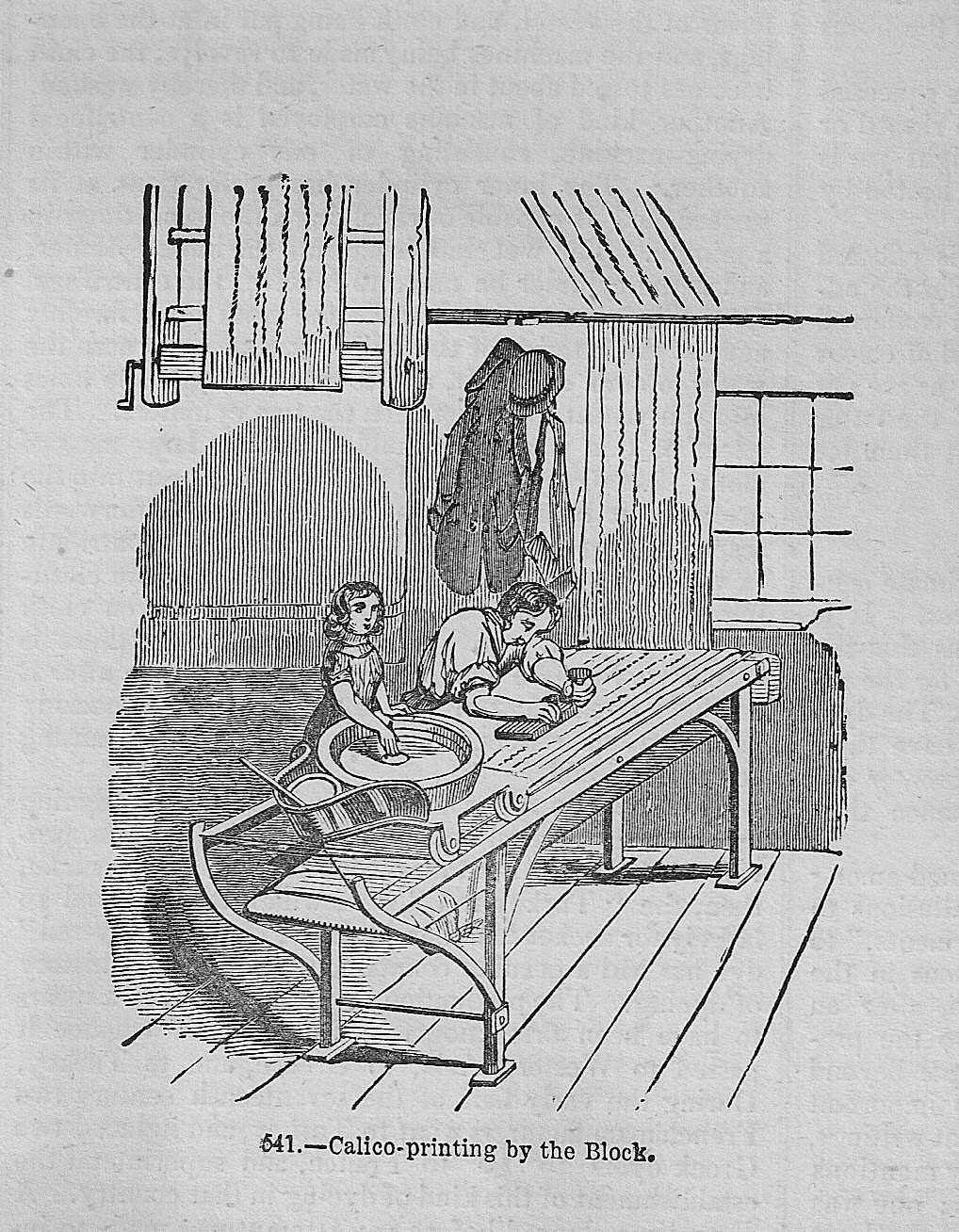
Originally, calico was printed by hand. The cloth was stretched across a printing table, wound round a roller at each end so that the cloth could be wound on ready for the next length to be printed. The printer had a child helper, a ‘tierer’, who dipped a small brush in a pot of colour, then brushed the liquid colour evenly onto a sieve or drum floating on a bed of water. The printer then placed an engraved wooden block or copper plate (with a handle on the back), onto the sieve so that it picked up the dye. The block was then pressed firmly onto the fabric to create a pattern. Block-printing was a slow process; it could take all day to produce just six pieces of cloth printed with a plain pattern

The first recorded calico printer in Manchester is William Jordan, ‘callique-printer’ at Little Green in 1763; the trade in Lancashire gained a strong foothold the following year at Clayton’s factory in Bamber Bridge, near Preston.
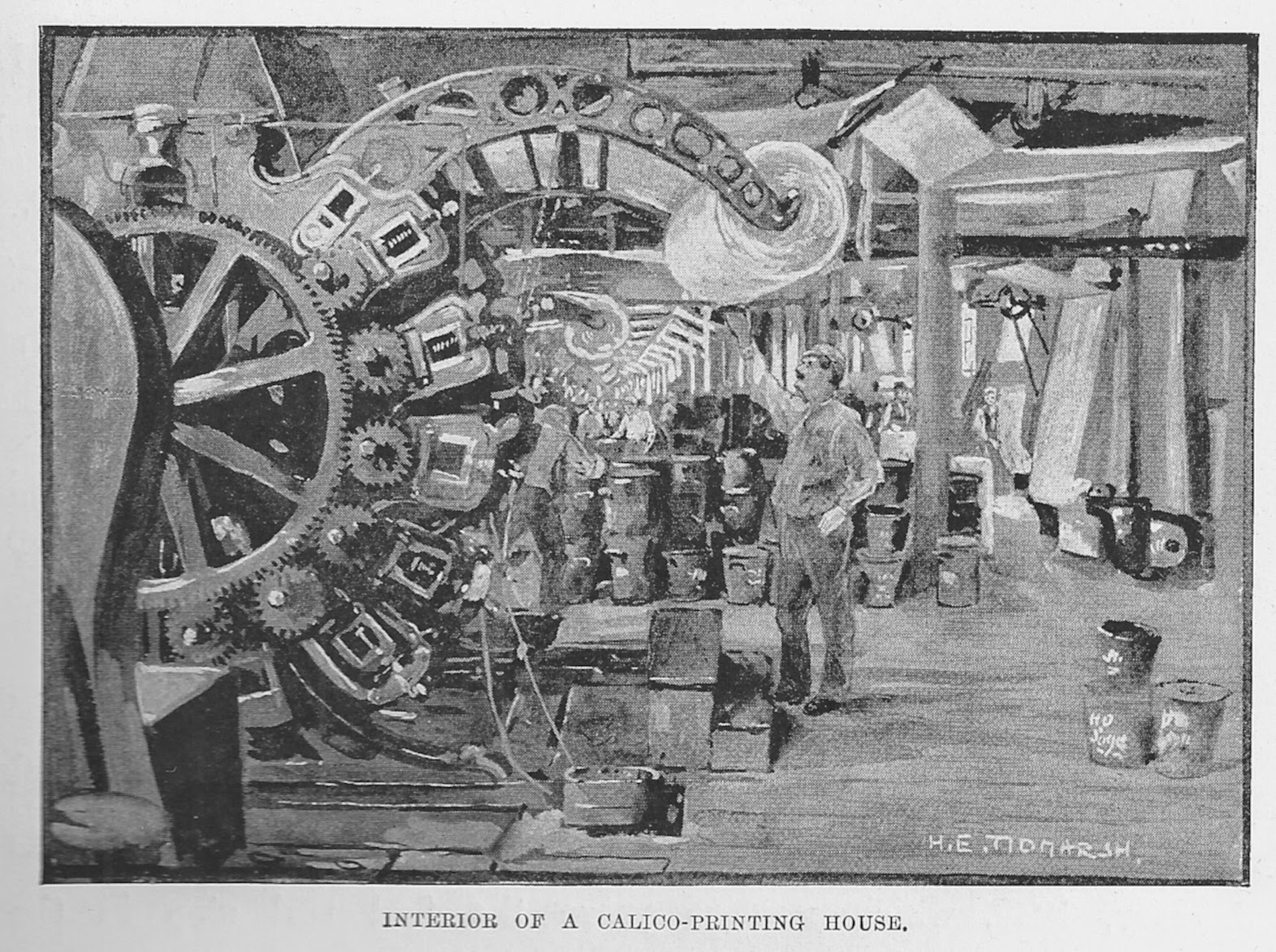
The days of block printing were numbered when roller or cylinder-printing was patented by Thomas Bell in 1783. A rotating cylinder was dipped into a trough of colour dye; next, a long steel rule or ‘doctor’ removed excess colour from the cylinder. The cloth to be printed was pressed against the dye on the engraved cylinder by means of a roller, so that the pattern was continuously printed on it as it moved along. Children were employed in the print-work factories, too.
Now hundreds of pieces of cloth could be printed in a day.  
Hoyle’s Mayfield works at Manchester employed over 200 workers in the 1830s, including over 40 children; the children earned 2s 6d per week when learning the trade, then 3s 6d when ‘fully instructed.’
You can find out more about the lives of child print-workers in my book Young Workers of the Industrial Age, and the Lancashire textile industry here.


Illustrations from author's collection:


Block printer and tierer or ‘tear girl’ (above, left). Children as young as six worked for twelve hours or more helping block printers. Charles Knight’s Pictorial Gallery of Arts Vol. I, (c.1862). 
A calico printworks at Manchester in the 1890s (above, right), and a view of Hoyle's printworks from London Rd Station (left). Both illustrations by H E Tidmarsh, Manchester Old and New Vol. II, (Cassell & Co., c. 1894).