Search This Blog

Showing posts with label bicentenary. Show all posts

Tuesday, 23 April 2024

Lord Byron Bicentenary

Lord Byron.

19 April was the 200th anniversary of Lord Byron's tragically early death at Missolonghi, Greece. 

This 'poor little rich boy', born in 1788, was the son of 'Mad Jack', as Captain Byron was known, and Catherine Gordon of Gight. 

Byron spent his childhood in Aberdeen, and was later educated at Harrow.

When Byron succeeded to the baronetcy in 1798, he discovered that his predecessors had squandered the family fortune. The ancient family home, Newstead Abbey, was ruinous and forlorn. 

'Hours of Idleness', his first collection of poems, was published in 1807, but received short shrift from some reviewers.  However, it was the publication of Childe Harold (1812), which brought Byron instant fame. 


Newstead Abbey. 


A chaotic and colourful love life - including, many believe, a relationship with his half-sister Augusta - and a disastrous marriage to Annabella Milbanke led to a different kind of notoriety.

Byron left England for good in 1816. He never saw his divorced wife, or their little girl, Ada, again. 


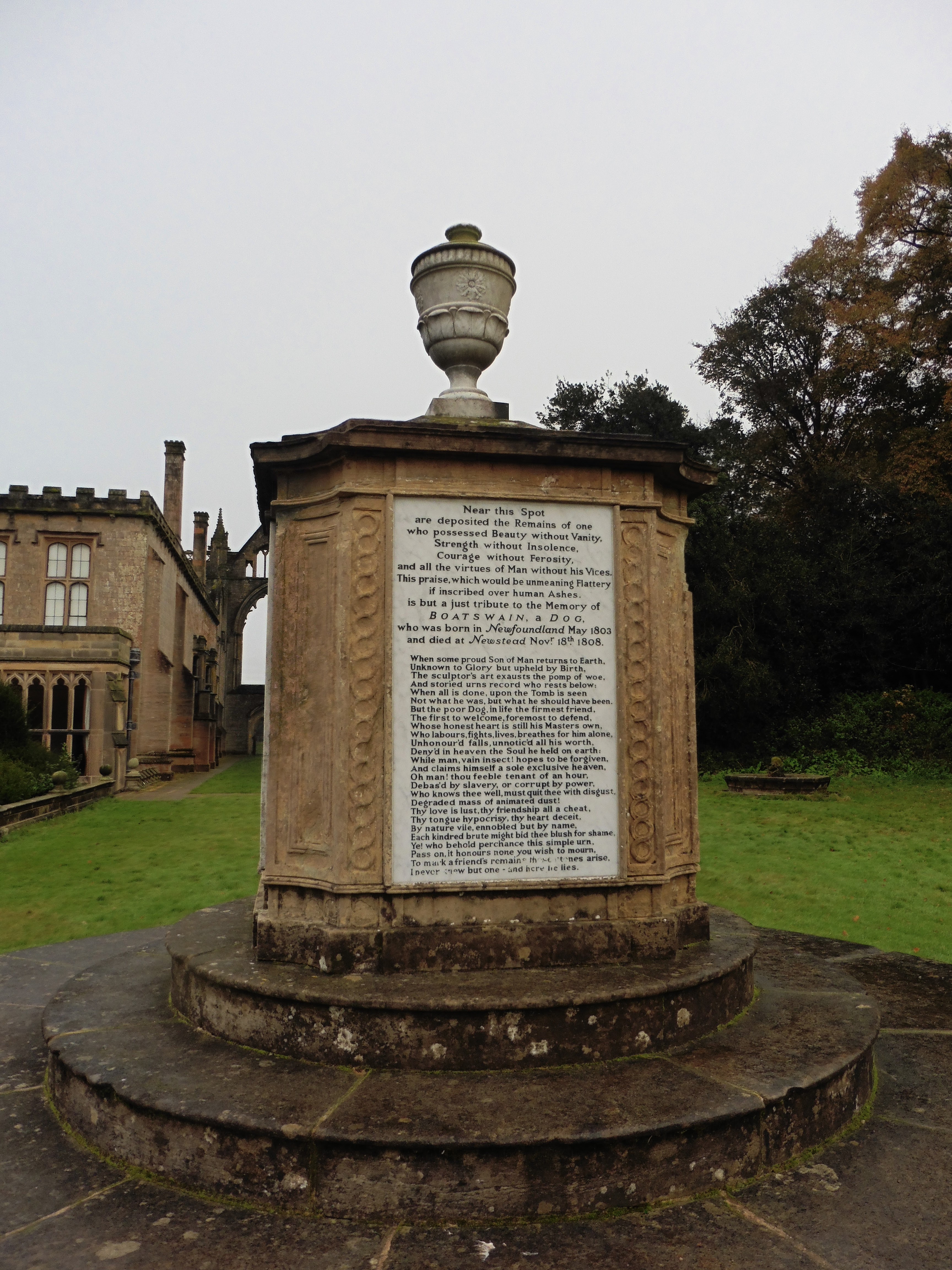
Bosun's Monument, Newstead.


Lord Byron travelled widely - Switzerland, Italy, and Greece - and you can explore an interactive map of his travels here. 

His relationships with Percy Bysshe Shelley, Mary Shelley, Claire Clairmont would fill a book by themselves.


Cascata Delle Marmore, near Terni.


Lord Byron visited this 'matchless cataract' near Terni in 1817 (image on the right).


Byron lived a full life abroad. There was a torrent of new poems, lovers, travels, history, architecture. But he wanted a cause to believe in - and the need for freedom for the Greek people truly inspired him.

He arrived in Greece in 1824, ready to fight for freedom. However, his doctors, and a fever,  proved too much for Lord Byron. 

The Byron Society has a list of events planned for the bicentenary here. 


Byron's Residence at Missolonghi in 1824. 


Images:

Lord Byron. Published by James Robins & Co., 1824.

Newstead Abbey. © Sue Wilkes.

The dog Bosun's monument, Newstead Abbey. © Sue Wilkes.

A bust of Lord Byron in the gardens of Newstead Abbey. © Sue Wilkes.

Cascata Delle Marmore, © Sue Wilkes.

'Lord Byron's Residence at Missolonghi' where he died in 1824. An 1827 engraving by H.Raper and R.Roberts, author's collection. 

Tuesday, 7 January 2020

Cato Street Conspiracy Bicentenary

This year marks the bicentenary of the Cato Street Conspiracy. My latest feature for Jane Austen's Regency World magazine looks at the story behind the capture of some of Britain's most desperate revolutionaries on 23 February 1820. 

You can see a contemporary 'Narrative' of the Conspiracy here on the British Library website, and some original documents relating to the conspirators here on the National Archives website. The Treasury Solicitor papers at the National Archives also include a weapon that was used in evidence at the trial of Arthur Thistlewood and his crew.
Arthur Thistlewood.

An exhibition on George IV's reign, 'Georgian Delights', is currently on show at the Weston Gallery, Lakeside Arts Centre, Nottingham. Dr Richard Gaunt, the exhibition curator, will give a talk on Cato Street on 24 February at the Djanogly Theatre.

You can also find out more about the background and build-up to the Cato Street Conspiracy in my book Regency Spies.

Thursday, 22 March 2018

Mary Shelley's Frankenstein

Bath Abbey
My latest feature for the 2018 Discover Your Ancestors bookazine (order here) is on Mary Shelley and Frankenstein. This landmark novel was published 200 years ago (Arizona University has a celebratory project here). Frankenstein; or, the Modern Prometheus electrified the reading public when it first appeared. The story of hapless experimenter Frankenstein, his Creature’s torment, and the fearful revenge It wreaked on his creator, is now embedded in our cultural mindscape. 

The Shelley Frankenstein Festival is planning more events to commemorate Frankenstein, including a theatre production of a re-imagined version of Frankenstein, at the Shelley Theatre, Boscombe in May.


Images:
West front of Bath Abbey, Penny Magazine, 13 July 1833.  During the autumn of 1816, Mary worked on ‘Frankenstein’ while she, Shelley and Claire Claremont stayed in lodgings near the Abbey. Author’s collection.
The Galvanic apparatus.Coloured engraving, 1804, by J. Pass, after H. Lascelles. Courtesy the Wellcome Library, no. 47529i.

Tuesday, 3 January 2017

Back To Work!

I hope you all had a fantastic break! I have got lots of work to do over the next few weeks, so there may be radio silence for a while. In the meantime, for the bicentenary of Jane Austen's death, I have a feature on Austen's life coming up in the Discover Your Ancestors 2017 bookazine.
On the family history front, the January issue of Your Family History has my article on researching small businesses. Sometime in April, my new book, Tracing Your Manchester and Salford Ancestors will be published by Pen & Sword.
Events are also being planned for the bicentenary of the Pentrich Rebellion this June, and you can read the story of the rebels and their fate in Regency Spies.
Image: ‘The late E.W. Roylance’. At least four generations of the Roylance family, grocers and importers, were engaged in the Irish and foreign butter trade in the Manchester area. H.B. Wilkinson, Old Hanging Ditch, Sherratt & Hughes, 1910.

Wednesday, 4 April 2012

The Risings of the Luddites

The years 1811 to 1813 were marked by great poverty for workers in many trades. The war against Napoleon had led to high food prices and difficult trading conditions.In Nottinghamshire in November 1811, framework knitters protested against cheap, shoddy hosiery by smashing stocking and lace frames. In his maiden speech in parliament, Lord Byron (1788–1824) highlighted the hardships which working families were suffering, but despite his efforts, the government made frame-breaking a capital offence. Luddite activity peaked in the northern counties during April 1812.

In Yorkshire, resentment was running high amongst the woollen croppers or ‘shearmen’. They believed that new ‘shearing-frames’ were taking away their livelihoods. On Saturday 11 April, over 100 Luddites tried to break into Cartwright’s mill at Rawfolds in Yorkshire.
In Cheshire, food riots in Macclesfield on 13 April were followed the next day by attacks on cotton powerloom mills at Stockport. Then on 28 April Yorkshire mill-owner William Horsfall, well-known for his hatred of Luddites, was shot dead.
In Lancashire during the same month, a cotton powerloom factory at Middleton was targeted. Then on 24 April, Wroe and Duncroft’s factory at Westhoughton was torched. Many of the Lancashire and Yorkshire Luddites later died on the gallows.

You can find out more about the Luddites’ stories and why they took direct action in the forthcoming May issue of Jane Austen's Regency World.
Update April 2015: My forthcoming book Regency Spies (which if all goes well with be published by Pen & Sword later this year), will discuss the authorities' hunt to find the Luddite leaders, and the spies who tried to infiltrate the ranks of the frame-breakers.


Images: Interior of John Wood’s cropping shop: headquarters of the Yorkshire Luddites. Rising of the Luddites, Chartists & Plug-Drawers, 3rd edition, (Brighouse, 1895).
Lord Byron. Great Authors of English Literature, W. Scott Dalgleish, (Thomas Nelson and Sons, 1899).
Lancaster Castle. Lancashire Luddites were tried and executed here after the 1812 riots. Engraved by T. Higham from a drawing by T. Allom. People’s Gallery of Engravings Vol.2 (Fisher, Son & Co., 1845). Both images from the author’s collection.


Tuesday, 7 February 2012

Charles Dickens: Champion of the Poor

Charles John Huffam Dickens was born on 7 February 1812, at Portsea, near Portsmouth. Lots of special events are planned for the bicentenary. Charles was the second child of John Dickens and Elizabeth Barrow, the daughter of a naval pay-officer. They married in 1809 and their first child, Frances (Fanny) was born the following year. A further six children were born after Charles; two died in early childhood.

John Dickens became overwhelmed by debt. Charles was heartbroken when his father was arrested for debt and jailed in the Marshalsea prison.
His parents could not afford to send him to school any more. They were very pleased, but Charles was horrified, when he was offered a job at Warren’s blacking warehouse, by Hungerford Stairs. Charles spent ten hours per day sealing and labelling pots of blacking (used for stoves); he earned six shillings a week. He felt ‘utterly neglected and hopeless’. But he ‘suffered in secret, and that I suffered exquisitely, no-one ever knew… I kept my own counsel, and I did my work’ (David Copperfield).
Charles never forgot the hardship of those years at the blacking factory. He became a fierce champion of poor and vulnerable people, especially children.
His first novel Oliver Twist (1837) told the story of workhouse orphan Oliver. To save money, ‘farmed out’ pauper children like Oliver to institutions like Mrs Mann’s house. The parishes gave these ‘baby farms’ money to care for each child. The less money the owners spent on food and clothes, the bigger profits they made. Parish overseers also apprenticed out poor children like Oliver to save money on their upkeep.
A decade after ‘Oliver Twist’ was published, a news story about pauper children made Dickens furious. Over 100 children, including 5 year old Bridget Quin, died from cholera at a ‘baby farm’ at Tooting during the winter of 1848-9.
The Tooting ‘baby farm,’ run by Mr Drouet, housed nearly 1400 children. Drouet was paid four shillings and sixpence (22½p) for each child. The children were dressed in rags. They didn’t get enough to eat. Their only vegetables were rotten potatoes. Some boys were so hungry they stole potato peelings from a bucket of pigswill used to feed pigs. Children slept three or four to a bed.
The Tooting children, already poorly from overcrowded beds, little food and not enough warm clothing, were easy victims for the killer disease of cholera. Dickens said the Tooting ‘farm’ was ‘brutally conducted’ and ‘vilely kept.’
In spite of Dickens’s efforts, when he died on 9 June 1870, many children lived in poverty (and still do). But without Dickens’s work, the social reforms of the Victorian age would have been even slower to arrive.

Images: Oliver Twist asks for more gruel in the workhouse.Illustration by George Cruikshank, The Adventures of Oliver Twist, (Chapman & Hall Ltd, and Henry Frowde, circa 1905).
Charles Dickens and autograph. Cassell’s Illustrated History of England Vol. IX, (Cassell, Petter and Galpin, c.1874). Author’s collection.