Search This Blog

Showing posts with label Pentrich Rising. Show all posts

Friday, 1 November 2024

As Poor As A Stockinger


 My latest feature in my continuing industrial series for Jane Austen's Regency World (November issue) is on framework-knitters (stockingers). 

Framework-knitters were extremely poorly paid. In March 1819, a Leicester framework-knitter, William Jackson, told a parliamentary select committee that none of the workmen earned more than six shillings a week (36p) on average, despite working a 15-hour day. 

Children helped their parents. Leicester had a wife and six children to support. He said that he earned eight shillings a week for making 'superfine' stockings, and he had 'put three of them into the frame' [i.e., making stockings], and they earned him 'nine shillings a week more'. William's wife did some seaming, for which she earned one shilling and sixpence. So their total income was 'eighteen shillings and sixpence'. The family was behind with their rent, and were in debt, even though Jackson had sold some of his belongings to try and make ends meet. 

Washing, fulling or 'felting' stockings. 

Probably one of the best-known stockingers was Jeremiah Brandreth, who was hanged for treason in 1817 following the ill-fated Pentrich Rising. Many contemporaries believed that Brandreth (a former Luddite), and his unfortunate companions on the gallows, was entrapped by a notorious government spy

Image of a stocking weaver courtesy of the Wellcome Library

Image of washing, fulling and felting stockings from Denis Diderot and Jean le Rond d’Alembert, Recuil de Planches de l’Encyclopédie Par Order De Matières, Tome Sixième, (Panckoucke, Paris, 1786). Author’s collection. 

Friday, 9 June 2017

The Pentrich Rising, 1817

Hunger and distress were the prime movers behind the ill-fated Pentrich Rising. On the same night as the abortive Huddersfield rebellion, the White Horse pub in Pentrich was the ‘nerve centre’ of the planned rebellion. The pub was owned by Nanny Weightman, mother of George Weightman, one of the chief ‘delegates’ involved in the uprising.
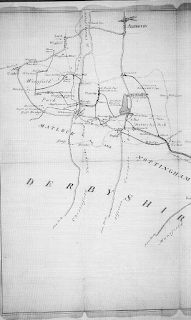
Jeremiah Brandreth, an out-of-work framework knitter known as the ‘Nottingham Captain’ and former Luddite, was now in charge of the rebellion (the ringleader, Tommy Bacon, was in hiding). Brandreth studied a map and pointed out the ‘line of march’ to his men. The rebels were to set off from South Wingfield at 10 pm, reach Pentrich by midnight, then ‘drive Butterley [the ironworks] before them’.

They planned to steal as many arms as possible, then march to Nottingham Forest and meet another large party of rebels. Brandreth said that Sheffield and Manchester would rise at the same time. This belief in simultaneous risings elsewhere had been actively fostered by the government's spies.

At the time appointed on Monday night (9 June), Jeremiah Brandreth, George Weightman and about sixty others, some with makeshift pikes, gathered at Hunt’s Barn in South Wingfield. Brandreth was armed with a gun and pistol; Weightman was armed, too.

The rebels divided into two ‘regiments’ to gather arms and recruits; Brandreth, Isaac Ludlam (armed with a spear) and ex-soldier William Turner were in the first group. They went to peoples’ houses, hammered on their doors and demanded weapons. The men of each household were asked to
Butterley Ironworks.
‘volunteer’ to join them; they threatened to shoot those who refused.

Tragedy struck when Brandreth and his men reached the home of Mrs Hepworth, a widow living with her sons. They banged on her door, but Mrs Hepworth refused to open it. The men shouted at her son William, ‘We must have your guns and your men, or we will blow your brains out’. Someone (probably Brandreth) fired through the kitchen window, and the bullet hit servant Robert Walters in the neck. He died shortly afterwards.

The rebels, about 100 in number, next went to Butterley Ironworks and tried to get in. But the works had been barricaded against them, and they left empty-handed. Some of the insurgents began to drift away. Then cavalrymen were spotted in the distance – the 15th Hussars, commanded by Captain Phillips, had been sent to investigate. The remaining rebels threw down their weapons and ran for their lives.
Letter re Brandreth and other rebels.

The Pentrich rebellion was over.

Jeremiah Brandreth, William Turner and Isaac Ludlam were hanged for high treason at the Friar-Gate Gaol, Derby, on Friday 7 November 1817. Fourteen other rebels were transported for life. You can read genealogies of the families involved in the Pentrich Rising here.


Images: Maps showing the area of South Wingfield and Pentrich (HO42/166), and a letter from two Nottingham magistrates, Charles L Morley and J H Barber, with ‘informations’ on oath to Lord Sidmouth that they suspected Thomas Bacon, Jeremiah Brandreth, Samuel Haynes and others of ‘treasonable practices’(HO44/166/f.410).
Butterley Iron Works. Author's collection. Pictorial Gallery of Arts Vol. I, (c. 1860).


Thursday, 8 June 2017

Folly Hall Bridge: A Forgotten Uprising

The old Luddite meeting place at Cooper Bridge.
Plans for the rising of 1817 were already under way before the notorious spy William Oliver arrived in the northern and midland districts of England – but his reiteration that the rebels would have help (10,000 men) from London must have swayed many waverers.
Thanks to their spies, the authorities now had the approximate date of the insurrection (9 June), the name of the main ringleader, ‘Old Tommy’ Bacon, and the names and addresses of those involved. The magistrates could have stepped in and made more arrests at any point, but they let events unfold unmolested. It’s difficult to escape the conclusion that the government was happy for the risings to go ahead to see how far the ringleaders were really prepared to go.
The rising in Yorkshire took place a day early (Sunday 8 June) because of a last-minute change of plan to rescue some would-be rebels recently arrested at Thornhill. The ‘revolution’ in the Huddersfield area broke out on with robberies as the men tried to get hold of arms.
Meanwhile, about 300–400 men assembled at Folly Hall Bridge (also known as Engine Bridge) about half a mile from Huddersfield along the road leading to Holmfirth and Honley. The men, armed with guns, pistols, and makeshift pikes, planned to march on Huddersfield when reinforcements arrived from the neighbouring villages. At midnight their leader, George Taylor, declared: ‘Now, my lads, all England is in arms – our liberties are secure – the rich will be poor, and the poor will be rich!’
About thirty minutes later the Huddersfield Yeomanry Cavalry, headed by Captain Armitage, went to reconnoitre the bridge, aided by the local constable, George Whitehead. As they approached the bridge, one man shouted ‘Who goes there?’ and aimed a gun at Whitehead. When Whitehead replied, the man took aim and fired, but it flashed in the pan.
After an exchange of fire, in which a cavalryman’s horse was wounded, the ‘Patrole found themselves compelled to retire to Huddersfield’ for reinforcements. When the soldiers returned, they found the rebels had already scattered and gone home. No-one else turned up to support the ‘revolution’; the Folly Hall Bridge rising was over.
But in Derbyshire, it was now time to ‘either fight or starve’, as we shall see tomorrow.

Tuesday, 3 January 2017

Back To Work!

I hope you all had a fantastic break! I have got lots of work to do over the next few weeks, so there may be radio silence for a while. In the meantime, for the bicentenary of Jane Austen's death, I have a feature on Austen's life coming up in the Discover Your Ancestors 2017 bookazine.
On the family history front, the January issue of Your Family History has my article on researching small businesses. Sometime in April, my new book, Tracing Your Manchester and Salford Ancestors will be published by Pen & Sword.
Events are also being planned for the bicentenary of the Pentrich Rebellion this June, and you can read the story of the rebels and their fate in Regency Spies.
Image: ‘The late E.W. Roylance’. At least four generations of the Roylance family, grocers and importers, were engaged in the Irish and foreign butter trade in the Manchester area. H.B. Wilkinson, Old Hanging Ditch, Sherratt & Hughes, 1910.

Thursday, 29 September 2016

Invisible Women?


Mary Wollstonecraft

Mary Wollstonecraft (1759–97) was one of the few women who spoke out during the turbulent era of Regency Spies to demand greater rights, and better education, for the female sex. Mary’s Vindication of the Rights of Man (1790) was a fiery reply to Edmund Burke’s reactionary response to the French Revolution’s ideals, Reflexions on the Revolution in France. Two years later, her Vindication of the Rights of Woman made her famous at home and abroad. But her untimely death following the birth of her daughter Mary, followed by husband William Godwin’s no-holds-barred biography, led to her ideas disappearing from view for many years.
But what did ordinary women think? Did they dream of a better society – or even of revolution? Sadly I did not have the space (or time) to explore this topic in Regency Spies, as noticed by Emma Jolly in her insightful review earlier this year.   
We know from newspaper reports that women like Hannah Smith (hanged at Lancaster Castle in 1812 for a Manchester food riot) sometimes took direct action during times of hardship. And female reformers from Oldham and Manchester were part of the vast crowd at Peterloo. (There’s more information on ‘Radical Women’, including Chartists, in my recent article in the September issue of Your Family History).
Peterloo Massacre
While researching Regency Spies, I found that women were only rarely mentioned as spies in the Home Office papers I studied (although as noted in my book, some evidence from this period is missing).  
One instance of a female spy is ‘Mary Brown’, listed in a ‘Key to Agents’ Names in Hampden Clubs’ in 1817. Women were seemingly more likely to act as informants; landladies sometimes had useful information for the authorities, as Radical meetings were often held in their pubs. (If any readers know of the exploits of any female spies, I would love to hear from you!).
Women were only occasionally mentioned by spies like William Oliver in their reports to the Home Office on rebel/revolutionary meetings. Oliver took great care to list all the men present, but this does not necessarily mean that women were absent; it could just mean that he thought that men were more of a threat to law and order.  
However, Henry Sampson, the Nottingham spy who was providing local reports on the Pentrich rebels, does say that Jeremiah Brandreth’s wife Ann was present while they were discussing ‘the Job’ (the rebellion) – although Sampson does not give her name. After the ill-fated rising, Ann (then pregnant with her fourth child) walked all the way from their home in Sutton-in-Ashfield to Derby to see Jeremiah while he was awaiting execution.
Mary Lee HO42/168


Also amongst the Home Office papers is a statement made by Mary Lee of Holmfirth (HO42/168, 5 July 1817). She had to give evidence regarding the planned uprising in the Huddersfield area that year; her husband Richard was knee-deep in the preparations. She told the authorities that the first time’ she ‘heard anything of a Revolution’ was on 19 May, when a man called and told Richard that ‘the Revolution was put off’. But Richard claimed that he ‘did not know there was to be a Revolution’. 
It must have been very difficult for women like Mary to give evidence on oath, knowing that their evidence could have dire consequences for their menfolk.


Images:
Mary Wollstonecraft.
Dr Syntax in an inn listening to reformers’ talk. Courtesy Library of Congress LC-USZC4-3647.  
The Peterloo massacre. The Yeomanry slash men, women and children with their sabres at a meeting to demand parliamentary reform at St Peter’s Field, Manchester as the Riot Act is read from a window. J. L. Marks, No. 2 Sandy's Row Bishopsgate St., 1819. Courtesy Library of Congress. LC-USZ62-138639  
Deposition of Mary Lee at the National Archives, Kew. HO42/168.


Wednesday, 13 April 2016

Sidmouth's New Spy


On 28 March 1817, William Oliver, using the name Mr Richards, delivered a letter in person at the Home Office. He requested a ‘private interview’ with Lord Sidmouth to offer his services to the government, as he had ‘material information for the welfare and justice of this country’.

Oliver knew Charles Pendrill, one of Col. Despard’s fellow conspirators. But Pendrill was now one of Arthur Thistlewood’s friends, and Oliver realized he too must be on the Home Office’s list of suspects. Oliver acted fast to save his own skin.

Sidmouth saw him the same day and accepted Oliver’s offer. The home secretary told him that Pendrill was a wanted man - there was a warrant out for his arrest. So Oliver must have felt that he’d done the right thing. Sidmouth gave Oliver a new mission: to infiltrate the reformers’ meetings in central and northern England. Did they want parliamentary reform by peaceful means – or were they planning to take up arms?
But Oliver could not just stroll into the reformers’ meetings and start asking questions. Pendrill told Oliver that Joseph Mitchell, a firebrand reformer from Liverpool, had come to London to get the ‘London Patriots’ to act in concert with the ‘Country People, who were all ready to strike a blow as the only Effort...left to obtain a Reform in Parliament’.
Fortuitously, Pendrill said, Mitchell wanted some ‘intelligent active Person from London’ to come to the manufacturing districts with him. With Pendrill’s help, Oliver met Mitchell on 17 April in London. Within a week, Oliver was on his way north with Mitchell – little dreaming that just a few months later, he would be ‘outed’ by the press as an infamous spy...
Images:
‘Conspirators, or Delegates in Council’. On the far left, Lord Sidmouth (with a cane) is given a paper by former spy Thomas Reynolds (who was given a consulship). A huge ‘green bag’ full of Radical papers sits on the table. Seated on the right, from left to right are spies John Castle (with his back to the reader), William Oliver, then Canning and Castlereagh.  On the far right, honest John Bull looks through the window, horrified by the proceedings. George Cruikshank, 1817. Courtesy Library of Congress, LC-USZC4-6856.
The start of Oliver’s ‘Narrative’ of his dealings in the Thistlewood papers, HO40/9.

Tuesday, 25 August 2015

Regency Spies Now Available For Pre-Order!

I'm thrilled to announce that my forthcoming book Regency Spies is now available for pre-order from Amazon UK or from the publisher, Pen & Sword. Launch date is currently scheduled for 30 November 2015. 
Here's a preview of the blurb to whet your appetite:

                                                                          Regency Spies:  
                                            Secret Histories of Britain’s Rebels and Revolutionaries 


An Age of Revolutions
Sue Wilkes uncovers the hidden histories of Regency spies and the men they hunted. Eavesdrop on the secret meetings of Britain’s underground political societies of the 1790s and early 1800s. Discover the true stories behind the riots, rebellions, and treason trials in late Georgian Britain.

Regency Spies explores the plots, intrigues and perils of those thrilling times:      

  • Wolfe Tone’s ambitious plan to free Ireland from British rule      
  • Luddites incite arson and machine-breaking in Britain’s industrial heartlands
  • The doomed Pentrich uprising of 1817 
  • The race to stop the 1820 plot to murder cabinet ministers and seize control of the capital 

Inside Cover:
Sue Wilkes reveals the shadowy world of Britain’s spies, rebels and secret societies from the late 1780s until 1820. Drawing on contemporary literature and official records, Wilkes unmasks the real conspirators and tells the tragic stories of the unwitting victims sent to the gallows.

In this ‘age of Revolutions’, when the French fought for liberty, Britain’s upper classes feared revolution was imminent. Thomas Paine’s incendiary Rights of Man called men to overthrow governments which did not safeguard their rights. Were Jacobins and Radical reformers in England and Scotland secretly plotting rebellion? Ireland, too, was a seething cauldron of unrest, its impoverished people oppressed by their Protestant masters.

Britain’s governing elite could not rely on the armed services – even Royal Navy crews mutinied over brutal conditions. To keep the nation safe, a ‘war chest’ of secret service money funded a network of spies to uncover potential rebels amongst the underprivileged masses. It had some famous successes: dashing Colonel Despard, friend of Lord Nelson, was executed for treason. Sometimes, in the deadly game of cat-and-mouse between spies and their prey, suspicion fell on the wrong men, like poets Wordsworth and Coleridge.

Even peaceful reformers risked arrest for sedition. Political meetings like Manchester’s ‘Peterloo’ were ruthlessly suppressed, and innocent blood spilt. Repression bred resentment – and a diabolical plot was born. The stakes were incredibly high: rebels suffered the horrors of a traitor’s death when found guilty. Some conspirators’ secrets died with them on the scaffold...  


James Gillray, 'End of the Irish Invasion and Destruction of the French Armada'. Courtesy Library of Congress, LC-USZC4-8768