
Last week we visited the 'Children of the Pits' exhibition at
Radstock Museum. I was particularly looking forward to seeing the exhibition because it was inspired by my book
The Children History Forgot, and we were not disappointed.
We were given a tremendous welcome by exhibition organiser Wendy Walker, researcher Anny Northcote and chairman Clem Maidment.
A big 'thank you' to everyone who took the time to chat to us, and particularly Wendy, who showed us round the museum.
The exhibition was put together by a team of researchers, and illustrated with photos and artefacts from the museum collection, and artwork by Kilmersdon Art Group. It shows the conditions endured by the young child miners of the
Somerset coalfield in the nineteen and twentieth centuries.

Somerset was once a
busy mining area, and even in comparatively modern times, young lads pulled sledges (putts) loaded with coal underground using the notorious '
guss and crook' (below), a harness made of rope (which went around the waist) and a chain, which was attached to the putt.

In 1907 at Dunkerton, the carting boys went on strike for higher wages. The boys were paid one penny a ton for the first 50 yards they dragged the coal, then halfpenny per ton for each succeeding 50 yards. The loads they dragged weighed 10-12 tons; this type of work was done by machinery or animals in other areas. One can imagine what hard, exhausting work it was.

This was a long, bitter dispute: strikers were fired on by the mine manager's son, and the boys did not win any extra money. The 'guss and crook' was used in the Somerset area
until the late 1940s.
The 'Children of the Pits' exhibition runs until the end of August. There are lots of interesting displays showing how people in the Radstock area lived and worked, and some Napoleonic era artefacts. Do drop in and visit if you get the chance.
The Children History Forgot explores working conditions for children in many different industries in the nineteeth century, and reformers' battles to improve their lives and help them go to school.
And if you would like to research your own ancestors' working lives when they were children, my new book
Tracing Your Ancestors' Childhood will be out soon: you can pre-order it from
Amazon or direct from
Pen and Sword.
All photos © Sue Wilkes. My photos of the Museum's displays and exhibits taken by kind permission of Wendy Walker.
Images:
Model of a young miner pulling a sled with the guss and crook at Radstock Museum.
Wendy Walker and Anny Northcote pictured at the museum with the exhibition poster and some artwork by Kilmersdon Art Group.
Guss and crook exhibit.
Photo of child miners in the 1900s - Radstock Museum exhibit (above left).
Pit winding gear wheel from Kilmersdon Colliery.
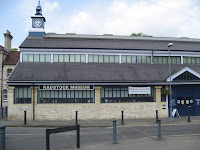
Radstock Museum (below).

Miner's cap and candle exhibit (right). Miners carried a candle pushed into their cap for light.


