Search This Blog

Showing posts with label calico printing. Show all posts

Tuesday, 14 May 2024

'A Very Pretty Spotted Muslin'


In Northanger Abbey, Miss Tilney wore a 'very pretty spotted muslin'.  My latest feature in my ongoing series for Jane Austen's Regency World (May/June issue) is on calico-printing. You will be able to find out more about the lives of child workers in the calico-printing industry in my forthcoming book, Young Workers of the Industrial Age, to be published by Pen & Sword this autumn. 


Images from the author's collection:

Above: Morning Dress, Lady’s Monthly Museum, February 1801. Figure on the right is wearing a ‘printed cotton gown’ with a ‘stone-coloured pelisse, trimmed with fur. A white velvet bonnet, crossed with green velvet bands’. 

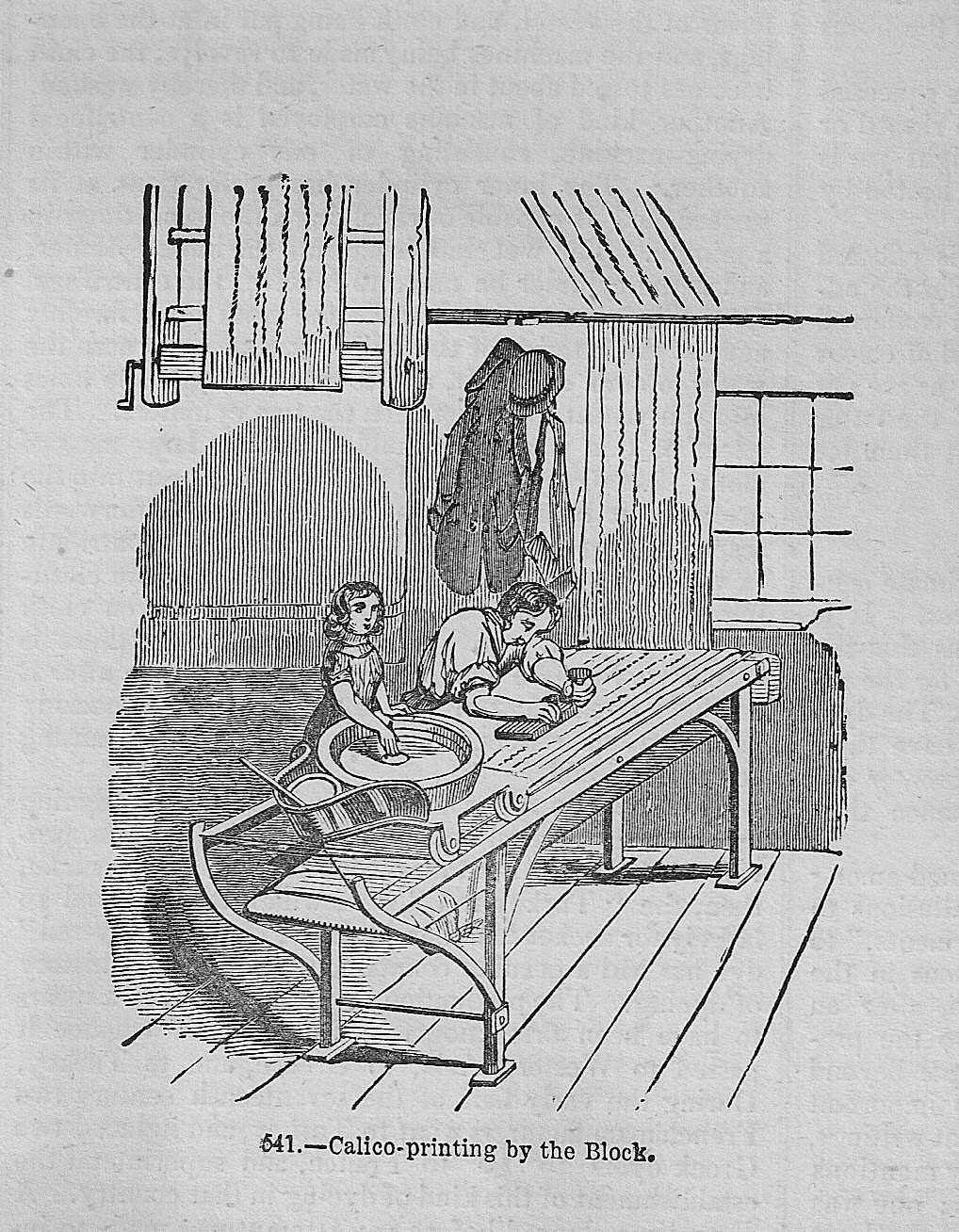
Image right: Block printer and tierer or ‘tear girl’. Children as young as six worked for twelve hours or more helping block printers. Charles Knight’s Pictorial Gallery of Arts Vol. I, (c.1862).

Monday, 29 September 2014

Calico Print Workers

My latest feature for Who Do You Think You Are? magazine (October issue) is about Lancashire calico-printing workers, and how to research your ancestors in that branch of the textile industry
Originally, calico was printed by hand. The cloth was stretched across a printing table, wound round a roller at each end so that the cloth could be wound on ready for the next length to be printed. The printer had a child helper, a ‘tierer’, who dipped a small brush in a pot of colour, then brushed the liquid colour evenly onto a sieve or drum floating on a bed of water. The printer then placed an engraved wooden block or copper plate (with a handle on the back), onto the sieve so that it picked up the dye. The block was then pressed firmly onto the fabric to create a pattern. Block-printing was a slow process; it could take all day to produce just six pieces of cloth printed with a plain pattern

The first recorded calico printer in Manchester is William Jordan, ‘callique-printer’ at Little Green in 1763; the trade in Lancashire gained a strong foothold the following year at Clayton’s factory in Bamber Bridge, near Preston.
The days of block printing were numbered when roller or cylinder-printing was patented by Thomas Bell in 1783. A rotating cylinder was dipped into a trough of colour dye; next, a long steel rule or ‘doctor’ removed excess colour from the cylinder. The cloth to be printed was pressed against the dye on the engraved cylinder by means of a roller, so that the pattern was continuously printed on it as it moved along. Children were employed in the print-work factories, too.
Now hundreds of pieces of cloth could be printed in a day.  
Hoyle’s Mayfield works at Manchester employed over 200 workers in the 1830s, including over 40 children; the children earned 2s 6d per week when learning the trade, then 3s 6d when ‘fully instructed.’
You can find out more about the lives of child print-workers in my book Young Workers of the Industrial Age, and the Lancashire textile industry here.


Illustrations from author's collection:


Block printer and tierer or ‘tear girl’ (above, left). Children as young as six worked for twelve hours or more helping block printers. Charles Knight’s Pictorial Gallery of Arts Vol. I, (c.1862). 
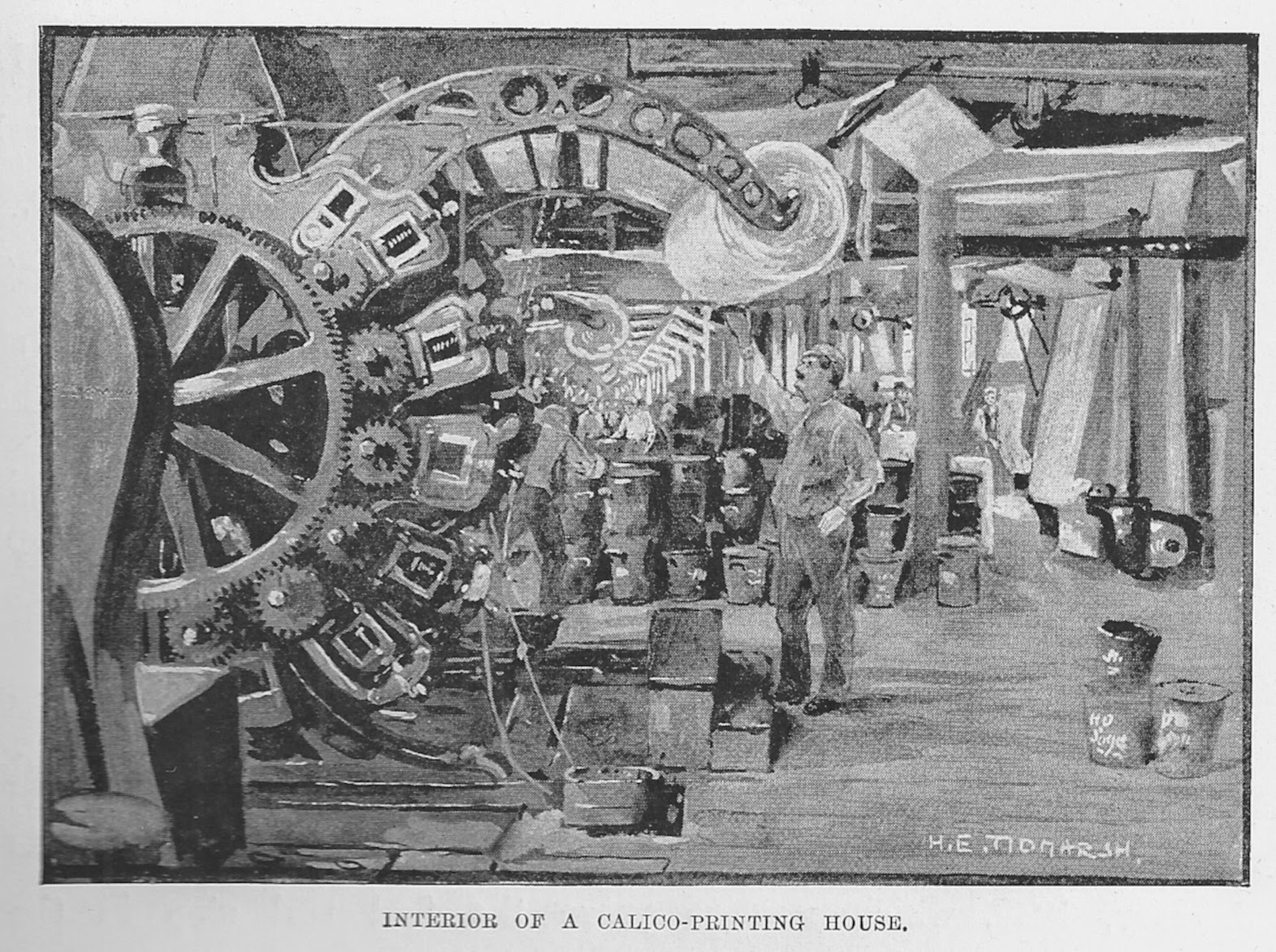
A calico printworks at Manchester in the 1890s (above, right), and a view of Hoyle's printworks from London Rd Station (left). Both illustrations by H E Tidmarsh, Manchester Old and New Vol. II, (Cassell & Co., c. 1894).

Wednesday, 17 October 2012

Visit to BBC Radio Blackburn

Just a quick update to say I've been invited to speak on the Ted Robbins show on BBC Radio Blackburn next Wednesday - 24 October. I'll be talking about my new book, Tracing Your Lancashire Ancestors, and if time permits, exploring some of my own ancestors' stories, and giving listeners tips on how to explore their own family tree.

It will be very interesting to visit Blackburn, which was famous for its 'greys' (fustians), and was also the original home of the famous Peel family of cotton manufacturers, who began the art of calico printing by rollers in Lancashire. I am really looking forward to exploring the town.


Image:
Fish Lane, Blackburn, traditional birthplace of Sir Robert Peel, first baronet (1750–1830).  Engraving by Evans from a drawing by Cardwell.  Pictorial History of the County of Lancashire, 1844.

Sunday, 18 January 2009

Stolen Childhoods Talk


I’ll be giving a talk to the Gaskell Society at 1pm on 10 February at the Cross St Chapel, Manchester. During late Georgian and Victorian times, children worked long hours in many different industries: coal, cotton, glass and metal trades. I’ll be looking at their daily lives and working conditions. If you are attending the talk and have bought my book Narrow Windows, Narrow Lives, if you bring your copy I’ll sign it after the meeting has finished.

Image: Calico Printing, 1840s. Pictorial History of the County of Lancashire, 1844. Child workers in the roller printing works (illustrated here) were usually about ten years old; this little girl is probably helping her father rather than working full time.