Search This Blog

Showing posts with label Robert Burns. Show all posts

Tuesday, 15 February 2022

Robert Burns' Mauchline

Burns House Museum
 Scotland's national bard, Robert Burns, lived in Mauchline with his long-time sweetheart Jean Armour from the spring until the autumn of 1788. His farm, which he shared with his brother Gilbert, was at nearby Mossgiel

While at Mossgiel, Burns wrote some of his most famous poems, including To A Mouse, The Twa Dogs, The Holy Fair, and The Cotter's Saturday Night

Jean, the daughter of a local stone-mason, was pregnant with twins for the second time. (One of her first twins had sadly died). She had been thrown out by her parents, who were furious when they found that Burns had got her pregnant again.

For her confinement, Robert found her a room in Mauchline (on the upper floor of the Burns House Museum, left). At this date, Burns believed that the couple were no longer married, as Jean's family had destroyed a piece of paper which showed they had wed informally.

Statue of Jean Armour, Mauchline.

Unfortunately, Jean lost both her twins shortly after their birth. Shortly afterwards, Jean and Robert were formally married by the local justice, Gavin Hamilton. 

Meanwhile, Burns was on the look-out for a new farm, as Mossgiel was not proving profitable. He settled on Ellisland Farm. However, its house was not habitable, so Robert set about building his family a new home. Burns, Jean, and their young son Robert, moved to Ellisland in December 1788. 


Mauchline is a bustling small town, and you can still see many of the buildings that Burns and Jean knew (see below). 


The 'Sma' Inn' which belonged to Nanse Tinnock ('Poosie Nansie') in Castle Street is part of the Burns House Museum site.

Another inn owned by Nanse Tinnock (pictured with Burns on the left) is on the corner of Loudon Street and Cowgate (photo, below right).  


Mauchline church is not the same building as the one known by Burns, as it was replaced in 1829. 


However, there are several interesting memorials of Mauchline folk who Burns was acquainted with, some of whom are mentioned in his poems. 


Armour Monument. 
Several relatives are also buried in the kirkyard - his brother John, and four of Robert's children by Jean Armour. 

Daddy Auld's Monument.


Title page of a volume of Burns' poems, 1813. 


Wednesday, 29 May 2019

Free Preview of Vignettes!

Jane Austen
You can enjoy a free preview of my new Amazon Kindle e-book Vignettes here!  Click on the link to read a free sample and discover the wonderful literary world of Jane Austen.

Vignettes is based on the many articles I’ve written over the years for Jane Austen’s Regency World, mostly mini-biographies of famous writers who either influenced Austen, or were contemporaries of hers. The authors chosen just happen to be my own personal favourites.


Vignettes begins with a brief introduction to Austen’s life and work.

The next chapter looks at women’s education at that date, with reference to how Austen’s contemporaries discussed it. Mary Wollstonecraft’s thoughts on daughters’ schooling, Priscilla Wakefield, Mrs Barbauld and others are included. I also discuss women’s magazines and how they helped to influence and educate young women at that time. The chapter concludes by looking at some contemporary critiques of the supposed pernicious effect of novel-reading.

The following chapter looks at the lives of Hogarth, Rudolph Ackermann, Johnson and Boswell. 
The chapter after that discusses Jane’s contemporary rivals like Ann Radcliffe, Mary Brunton, Fanny Burney and Mme de Stael.

After a chapter on social ‘influencers’ like Parson Malthus, Thomas Bernard and Robert Owen, we move on to discussing the lives of Cowper and Thomson, William and Dorothy Wordsworth, John Keats, Percy and Mary Shelley, Robert Burns, Sir Walter Scott, etc. Wherever possible, I have set each author in the context of Jane’s life and works by including quotes from her letters and novels. 

Wednesday, 15 May 2019

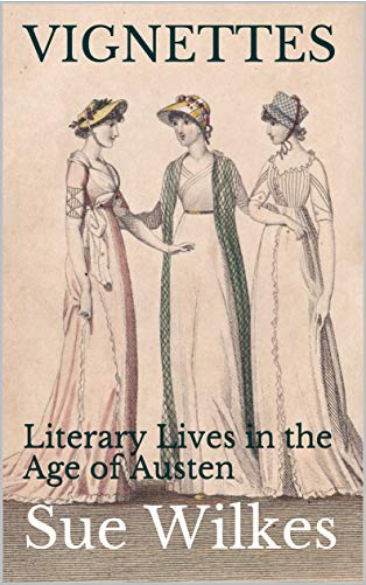
My New E-Book: VIGNETTES

I'm very pleased to announce that I've just published a new book on Amazon Kindle: 'Vignettes: Literary Lives in the Age of Austen'.

Here's a copy of the blurb:

'Jane Austen lived in a ground-breaking era for English Literature. This was the age of William Wordsworth, Percy and Mary Shelley, John Keats, and others. Austen herself drew inspiration from the writers who came before her, like Doctor Johnson, Thomson, Cowper and Fanny Burney. She faced stiff competition from the rival novelists of her day like Ann Radcliffe, Mary Brunton, and Walter Scott.
Jane Austen's House Museum, Chawton. 
Away from the novelists’ world, writers like Mary Wollstonecraft argued passionately for women’s rights, and Parson Malthus, Robert Owen and Thomas Bernard discussed how best to deal with the poor.
Based on the author’s previously published articles in Jane Austen's Regency World magazine, this lively exploration of Austen’s times also looks at popular literature. How did our tradition of Christmas ‘annuals’ begin? Were female novel-readers really the ‘slaves of vice’? Find out more in 'Vignettes'. '

Robert Burns. 
The book also discusses the career of poet Robert Burns, writer Robert Southey, and publisher Rudolph Ackermann.

I hope you enjoy reading it as much as I've enjoyed researching the stories of all these wonderful writers over the years!

Saturday, 21 January 2012

The Poet's Choices

Robert Burns faced some of the most critical choices of his life during his late twenties. Scotland’s bard was tormented by indecision. How could he best make a living: as a poet, farmer, or excise-man? Should he share his life with a lady of good birth and education, or a woman of his own class?

On 13 March 1788, Burns agreed to lease Ellisland, only a few weeks after saying he had no intention of ‘beggaring’ himself by taking a farm. Burns loved the countryside around Ellisland. As he walked by the banks of the ever-rippling River Nith, he composed some of his most famous poems, including the classic Tam O' Shanter.
You can find out more about Burns’ life at Ellisland, and about the life choices he made there, in my feature for the latest issue of Highlander magazine.
Images: Engraving of Robert Burns. Great Authors of English Literature, (Thomas Nelson & Sons, 1899).
Ellisland farmhouse © Sue and Nigel Wilkes.

Monday, 4 October 2010

Burns and Bruce

We’ve just returned from a lovely holiday in Galloway. We always enjoy exploring Dumfries, which is closely associated with two of the most iconic figures in Scottish history: Robert Burns and Robert the Bruce (the subject of my latest feature for Aquila children’s magazine).

It was here that Robert the Bruce slew the Red Comyn before the high altar of Greyfriars kirk in 1306, very close to the spot where Burns’s statue now gazes down on the town.


We were lucky enough to get a guided tour inside Dumfries’s Theatre Royal as part of a special ‘open doors’ day for historic sites in Galloway. Burns was a keen supporter of the theatre, and I believe the outside of the building is still pretty much as it was in his day.


Photos: Statue of Robert Burns, and the Theatre Royal, Dumfries. © Sue and Nigel Wilkes.

Monday, 25 January 2010

Burns Night

Today is the anniversary of the birth of Scotland’s Robert Burns. Burns left us a unique poetic legacy. He was born on 25 January 1759 in a humble cottage built of clay in Alloway, Ayrshire. Robert, the son of a farmer who gave him an unusually broad and cultured education, first ‘committed the sin of rhyme’ while still in his teens.

Burns’s life changed forever when his book of Poems, Chiefly in the Scottish Dialect was published in Kilmarnock in 1786. The ‘heaven-sent ploughman’ was always the subject of social controversy. During his lifetime, and in the years following his death, his private life threatened to overshadow his achievements. Did the frailties which helped make Burns a great poet hinder contemporaries’ appreciation of his work? In my latest feature for Highlander magazine, I discuss Burn’s life and loves, and his reputation as a man and poet during his lifetime and after his death.

Image: ‘O Tibbie, I Hae Seen the Day.’ Poem on Isabella Steven, daughter of a man near Lochlie (Lochlea) who owned three acres of peat moss. She consequently felt entitled to look down on the poet, then a young man.
Engraving from Complete Poetical Works of Robert Burns, (William P. Nimmo & Co., 1881.)

Friday, 26 June 2009

City of Culture


This is Scotland’s Homecoming year, and there are lots of celebrations planned in Edinburgh for this summer. Robert Burns called Edinburgh ‘Scotia’s Darling’, and the city has long been renowned as a centre for literature and learning. Burns, James Boswell and Sir Walter Scott are just a few of Scotland’s literary stars who lived there. You can find out more about Edinburgh and its history in my new feature for Scottish family history magazine Discover My Past Scotland.

Image: Statue of Burns (by Flaxman) in the National Gallery. The statue was originally in the monument to Burns on Calton Hill. Black’s Picturesque Tourist of Scotland (24th edition), (A& C Black, 1882.)

Sunday, 25 January 2009

Burns Night

Tonight’s a special Burns Night – the people’s poet is 250 years old today. He was born on 25 January 1759 in a humble cottage near Ayr. His poems brought him fame, but not wealth. Burns loved to socialise; I’m sure he would have enjoyed the many Homecoming events planned for this year.

Image: Robert Burns, Burns’ Poetical Works, (William P. Nimmo & Co., 1881.)