 |
| Chawton Church, Hampshire. |
Sunday, 15 March 2015
Church-going in Austen's Day

Terry Pratchett
I was deeply saddened by the news this week that Terry Pratchett had died. He was my favourite modern fantasy author, and he had a unique imagination and sense of humour. We have spent many happy hours in the car listening to his Discworld audiobooks, read by the inimitable Tony Robinson. A great loss to literature.
Thursday, 26 February 2015
A Stroll Round Saffron Walden

Saffron was an incredibly important product - it was used as a dye and as a spice.
The trade died out during the eighteenth century, but an enterprising farmer has recently begun growing saffron crocus again in the area.
 |
| Church St |
 |

Saffron Walden is also home to a museum, built in the mid-1830s. It's said to be one of the oldest purpose-built museums in the UK, although sadly we did not have time to pay it a visit.
 |
| Saffron Walden museum. |
 |
| Walsingham House. |

Saturday, 7 February 2015
Love and Marriage
 |
| Elinor makes Edward Ferrars the happiest of men. |
Friday, 6 February 2015
A Wonder of the Waterways
 |
| Top of Foxton Locks. |
Last year I
enjoyed a wonderful visit to Foxton Canal Locks and the site of its former boat lift. The staircase of locks at Foxton (on the Grand Union Canal, near Market Harborough) were a bottleneck for commerce as they
were only constructed wide enough to permit one narrow boat to enter at a time.
 |
| The bottom of the former inclined plane. |
To speed things up, an inclined plane or boat lift was constructed. This major
engineering feat, designed by Gordon Cale Thomas, opened on 10 July 1900. Two giant tanks of water, which
counterbalanced each other, carried either one wide boat or two narrow boats
per tank. A steam engine provided extra 'oomph' to power the lift.
Sadly the boat lift became uneconomic to use, and it closed just over
a decade after its grand opening. (The Anderton Boat Lift in Cheshire had a
much longer working life, and is now back in working order again).
The Foxton
Inclined Plane Trust cares for the site’s preservation, and hopes to create a
digital model of the boat lift.
 |
| Top of inclined plane, looking down. |
Unfortunately it seems most unlikely that this
wonder of the waterways will be restored to its former glory owing to the
prohibitive cost.
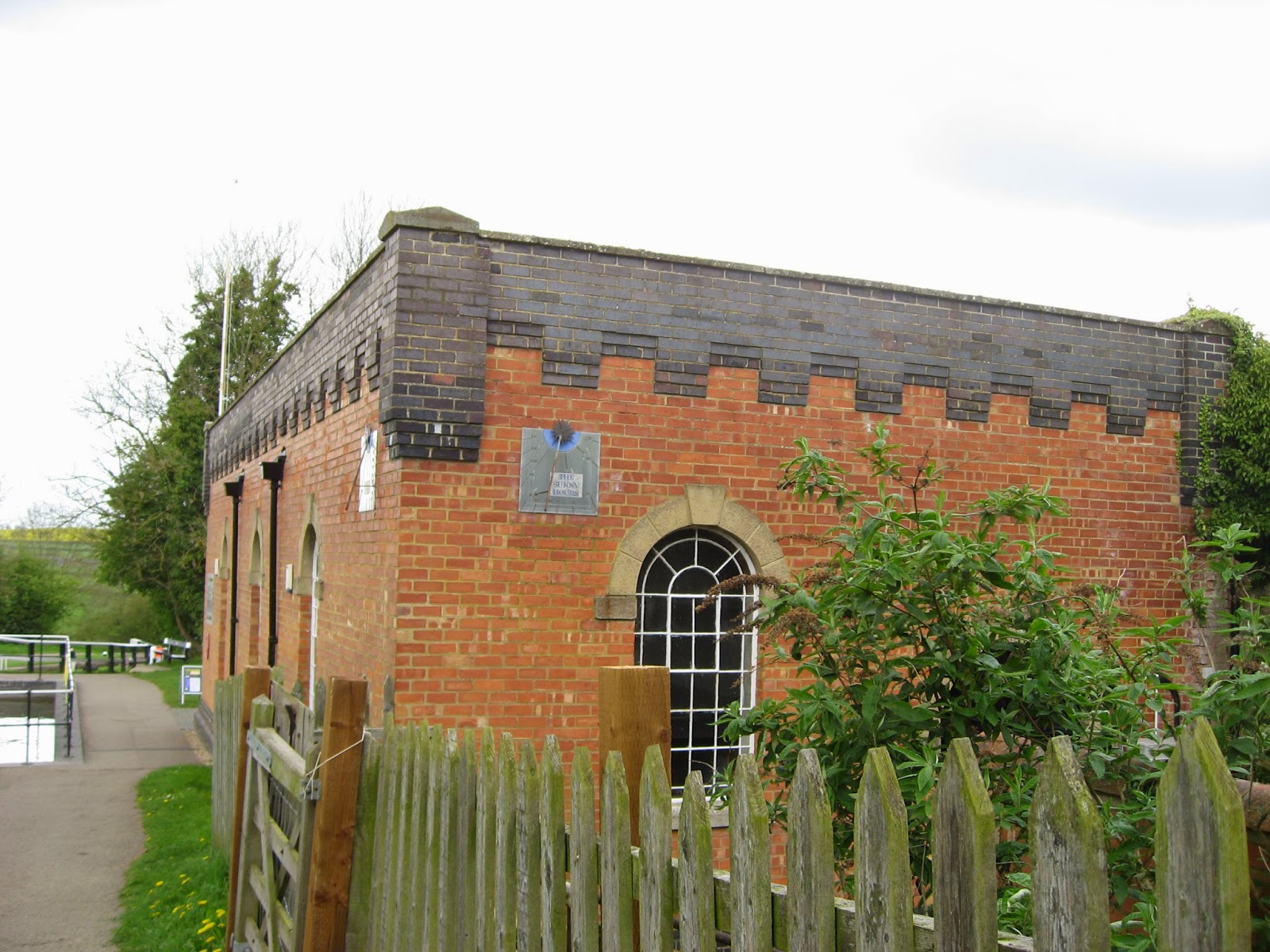 |
| Former boiler house, now a museum. |
But the site is extremely interesting to explore.The museum (in the old boiler house for the steam engine)
gives a wonderful insight into the days of working boats, and if you have canal ancestors you will really enjoy a visit.

The hull of this old boat (left) illustrates the level at which boats entered the lift.
 |
| Former lock-keeper's cottage, now a cafe. |

When a canal was frozen over, an ice boat like the Gordon Thomas (left) was rocked from side to side by boatmen to break the ice so that traffic could resume.
All photos copyright Sue Wilkes.
Saturday, 10 January 2015
Scotland's Industrial Past and Present
 |
| Map of Scotland, 1845. |
 Michael Portillo's Great British Railway Journeys is back with a new series. This week on the programme he visited some industrial sites and we've been treated to some fascinating archive footage of workers. During the second episode he had a ride on the Waverley paddle steamer, and visited the David Livingstone Centre at Blantyre - I was especially interested as I did not realize that the famous missionary was a child worker in a cotton factory. Episode 3 was another treat as Mr Portillo visited a modern steel rolling mill, the Clyde Falls at New Lanark, and explored the Union Canal and the Falkirk Wheel, which I would love to visit one day. Over the next few weeks, I'll be taking a look at some of the fabulous heritage sites I visited last year, but haven't had time to blog about yet, as I'm busy writing Regency Spies.
Thursday, 1 January 2015
Happy New Year!

Illustration: Mr Elton leaves an intriguing paper with Emma and Harriet in Jane Austen's Emma. C.E.Brock illustration courtesy of the wonderful Molland’s website.
Subscribe to:
Posts (Atom)