Search This Blog

Wednesday, 2 December 2015

Britons To Arms! Spa Fields 1816.

Spa Fields Chapel in the 1780s.
One group of particular interest to Britain's spymasters were the Spencean Philanthropists. These revolutionaries were followers of Thomas Spence. Spence believed that ‘the land is the people’s farm’. Land should belong to all, not just the ‘landed monopoly’. 
Spence's Plan. HO40/9, 1817.

After Spence's death in 1814, a new society was set up by his adherents, which included former LCS members Thomas Evans and his son Thomas, who were earning a living as brace-makers in the Strand. 

The Spenceans held weekly meetings at pubs in the metropolis. Their members included Dr James Watson, ‘a respectable surgeon and apothecary’, his son Jem or 'Young Watson', John Hooper, Thomas Preston – and Arthur Thistlewood, a brooding, dangerous man. 
In the autumn of 1816, the Spenceans wrote to Radical orator Henry Hunt, asking him to address a meeting at Spa Fields. Hunt, a very popular speaker, was sure to draw a large crowd. The Spenceans could use the meeting to test public support for their plans to overthrow the government. 
Hooper and Thistlewood.
The Spenceans told Hunt that they planned to hold a meeting ‘of the distressed inhabitants of the metropolis’ at Spa Fields on Monday 15 November.  They would prepare a memorial to the Prince Regent detailing the people's grievances and asking for relief. Hunt agreed to go. But when he arrived in London, and the Spenceans showed him the speech which they wanted him to read out, Henry was aghast:‘The whole affair was made up of Spencean principles, relating to the holding of all the land in the kingdom to be one great farm, or something of that sort’. It was ‘treasonable matter’. At last Hunt agreed to chair the meeting provided there was no mention of Spencean ideas. He wanted to concentrate on the reform of parliament - the introduction of universal (male) suffrage and annual parliaments. 
Shortly before the meeting, 5,000 handbills were distributed in London: 'Britons To Arms! The whole country waits the Signal  from London to fly to Arms! Hasten break open Gunsmiths and other likely places to find Arms!... Stand True or be Slaves for Ever!' (HO 40/3/3, f.901, 1816). 
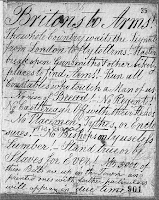
Although this meeting passed off peacefully, the next one, on 2 December, was a very different affair. The government's spies reported that the Spenceans planned to attack the Bank of England and and the Tower of London (very similar to the Despard plot).


So on the appointed day, troops and police were out in force in London. Dr Watson’s son Jem was first to address the crowd. He climbed on a coal-waggon decorated with tri-coloured flags: the emblem of the French revolution. 


When Hunt turned up at 1pm to address the 10,000-strong crowd, Young Watson was already heading towards Smithfield with several 
hundred men. Jem shot a customer, Mr Platt, while raiding a gunsmith’s shop. Several shops were attacked, and a mob rampaged through the streets until stopped by the troops and cavalry.The Spenceans were now wanted men...

The Home Office received regular updates as the riot was taking place. HO40/10.


Tricoloured flags.

Monday, 23 November 2015

The Spymasters II


During the age of the French Revolutionary Wars, the Home Office wanted good, reliable intelligence on the domestic front as well as in the sphere of war. Persons of interest to the authorities included the government's political opponents and critics, disaffected Englishmen, Irish and Scots, and even workers agitating for better wages and working conditions.

If the government believed that trouble was brewing, it was a far better use of resources to ensure that troops were already in place before they were needed, and this is one of the reasons why spies were needed. Whitehall relied heavily on reports from local magistrates and concerned loyalists for news of potential troublemakers in the provinces.
Many local JPs were active intelligence-gatherers.

Unfortunately many local justices seem to have been particularly pusillanimous and communicated every minor happenstance. Letters poured into the Home Office on a daily basis, and the clerks had the unenviable task of winnowing the chaff to determine which letters and spy reports were important and required immediate action, and which were trivial.

Several local officials employed spies and informers to gather information, which they forwarded to London. For example, magistrates like Col.Ralph Fletcher in Bolton, Rev. William R. Hay in Manchester, and clerk of the peace John Lloyd of Stockport, were highly active correspondents. Their spies and informers were given code-names in correspondence, such as ‘B’ or ‘S’; sometimes the term ‘confidential agent’ or ‘confidential person’ was used. 


Images:
John Bull fighting the French single-handed. Unknown artist, c. 1800. Courtesy Library of Congress LC-DIG-ppmsca-10749.
'The Bench'. Hugh Thomson illustration for Our Village, Macmillan & Co., 1893.


Monday, 16 November 2015

The Arrest of Colonel Despard

On this day in 1802, Colonel Edward Marcus Despard and over twenty other conspirators were arrested at the Oakley Arms pub in Lambeth on suspicion of high treason. Despard (1751–1803) had formerly served as chief engineer to Captain (later Lord) Nelson. Despard was an Irishman, and had been a member of the London Corresponding Society (LCS) of which Thomas Hardy was a founder member. The LCS wanted parliamentary reform.

Despard and other Radicals were imprisoned for suspected treasonable practices during the suspension of Habeas Corpus in 1798. (Sir Francis Burdett campaigned to get Despard and other prisoners held in appalling conditions in Coldbath-Fields released).  
KB8/87 Death sentences.

After his release from prison, Despard joined a secret society called the United Britons, which had links with the United Irishmen and United Englishmen. 

(The government believed that the United Britons was just another name for the United Englishmen. However, they appear to have had separate leaders at some dates). 

Despard's United Britons planned to rise up in unison with United Irish rebels in Ireland at the same time as a French invasion; they would seize the Bank of England, Tower of London, armouries, make ‘Insurrection Rebellion and War’ on the kingdom, and kill the king. Unfortunately for Despard, spies and informers had infiltrated his ranks, and their evidence helped convict Despard and his men. 

Was Despard an innocent man? He refused to admit his guilt, right up to his execution on 21 February 1803. And as the chief evidence against him came from informers, some contemporaries like Henry Hunt believed that Despard was 'stitched up' by the government. 
Update 22.1.16: You can read some of the newspaper coverage of the Despard plot here on the British Newspaper Archive blog.
Images: Colonel Despard, from the Memoirs of the life of Col. E. M. Despard (1803) held at the Working Class Movement Library. 
Photo showing the death sentence passed against Despard and his men. Special oyer and terminer and gaol delivery roll and file, Colonel Edward Despard and others, KB 8/87 at The National Archives.

Wednesday, 11 November 2015

The Spymasters I


Sir Francis Walsingham

To understand how the spy system worked during the era of Regency Spies, we must look at the machinery of government.  Official government departments dealing with domestic and foreign affairs had existed for centuries; for example, Sir Francis Walsingham was famous for his role as chief spymaster in Elizabeth I's reign. 
However, in 1782 the Home Department (Home Office) and the Foreign Department (Foreign Office) were established in a form roughly equivalent to those existing today. George III had two principal secretaries in charge of government affairs: one for the Home Department, and one for the Foreign Department.
George III
The Home Secretary (as we would call him today) was responsible for maintaining law and order. Henry Dundas was Home Secretary in the early 1790s, followed by the 3rd Duke of Portland, who served under Prime Minister Pitt the Younger. 
Initially, the Home Department’s staff consisted of a principal secretary, two under-secretaries, eleven clerks, two chamber-keepers’ and one ‘necessary woman’ (maid or housekeeper).
After France declared war on Britain in 1793, and fears of an invasion grew, the British government adopted a more professional, centralized approach to intelligence-gathering. The Home Office initially took charge of the war effort. The following year, a War Department was founded and an additional Secretary of State appointed.
The Home Office also set up the Alien Office, which kept tabs on foreign visitors (especially suspected French spies) to Britain, and deported them if necessary. Formerly, secret service work was undertaken when needed by an obscure body known as the Foreign Letter Office.
Under the leadership of the redoubtable William Wickham and Charles William Flint, the Alien Office became the unofficial headquarters of the secret service and a central clearing house for intelligence on foreigners. Its premises were near the prime minister’s official residence in Downing Street, and its officials were primarily Oxford graduates. By 1816 the under-secretary of state at the Home Office had taken over the Alien Office’s duties.
Westminster from the roof of Whitehall, c.1807.
War with France increased the Home Office’s workload and it took on extra staff. The Home and Foreign Offices also shared staff such as messengers, translators, and two ‘decipherers’ or decoders. They had a very important task. Since the early eighteenth century, Secretaries of State had had powers to issue warrants to post-masters and post-office clerks to intercept, open and decipher the letters of suspect personages. In Ireland, the Lord Lieutenant issued warrants to detain the mail if necessary.
A warrant to open mail did not necessarily relate to just one person; several individuals could be named as persons of interest. Warrant could also be issued for all letters potentially relating to a particular offence, such as treason or sedition. This gave the authorities great scope for surveillance. 
All images from the author's collection.