 |
| Spa Fields Chapel in the 1780s. |
 |
| Spence's Plan. HO40/9, 1817. |
After Spence's death in 1814, a new society was set up by his adherents, which included former LCS members Thomas Evans and his son Thomas, who were earning a living as brace-makers in the Strand.
The
Spenceans held weekly meetings at pubs in the metropolis. Their members included Dr James Watson, ‘a respectable
surgeon and apothecary’, his son Jem or 'Young Watson', John Hooper, Thomas Preston – and Arthur Thistlewood, a brooding, dangerous
man.
In the autumn of 1816, the Spenceans wrote to Radical orator Henry Hunt, asking him to address a meeting at Spa Fields. Hunt, a very popular speaker, was sure to draw a large crowd. The Spenceans could use the meeting to test public support for their plans to overthrow the government.
 |
| Hooper and Thistlewood. |
Shortly
before the meeting, 5,000 handbills were distributed in
London: 'Britons To Arms! The
whole country waits the Signal 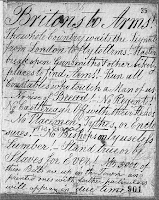 from
London to fly to Arms! Hasten break
open Gunsmiths and other likely places
to find Arms!...
Stand True or be Slaves
for Ever!' (HO 40/3/3, f.901, 1816).
from
London to fly to Arms! Hasten break
open Gunsmiths and other likely places
to find Arms!...
Stand True or be Slaves
for Ever!' (HO 40/3/3, f.901, 1816).
 from
London to fly to Arms! Hasten break
open Gunsmiths and other likely places
to find Arms!...
Stand True or be Slaves
for Ever!' (HO 40/3/3, f.901, 1816).
from
London to fly to Arms! Hasten break
open Gunsmiths and other likely places
to find Arms!...
Stand True or be Slaves
for Ever!' (HO 40/3/3, f.901, 1816).
Although this meeting passed off peacefully, the next one, on 2 December, was a very different affair. The government's spies reported that the Spenceans planned to attack the Bank of England and and the Tower of London (very similar to the Despard plot).
 So on the appointed day, troops and police were out
in force in London. Dr Watson’s son Jem was first to address
the crowd. He climbed on a coal-waggon decorated with tri-coloured
flags: the emblem of the French revolution.
So on the appointed day, troops and police were out
in force in London. Dr Watson’s son Jem was first to address
the crowd. He climbed on a coal-waggon decorated with tri-coloured
flags: the emblem of the French revolution. When Hunt turned up at 1pm to address the 10,000-strong crowd, Young Watson was already heading towards Smithfield with several
hundred men. Jem shot a customer, Mr Platt, while raiding a gunsmith’s shop. Several shops were attacked, and a mob rampaged through the streets until stopped by the troops and cavalry.The Spenceans were now wanted men...
 |
| The Home Office received regular updates as the riot was taking place. HO40/10. |
 |
| Tricoloured flags. |

