Search This Blog

Showing posts with label Thomas Paine. Show all posts

Monday, 13 June 2016

Mutiny!


Seamen complain about their rations.

First of all, apologies for the radio silence! My poor blogs have been much neglected over the last few weeks, as I've been very busy writing a new book, but hopefully I should have more time to spend on them now.
On 16 April 1797 the crews of the Royal Navy’s ships at Spithead, including the Queen Charlotte and Royal George, went on strike. They refused to put to sea as ordered until their pay was raised, and red flags of mutiny were run up the flagpoles.
The mutiny could not have come at a worse time, as a French invasion was expected at any time (there was a landing at Fishguard earlier that year). But the men had had enough. Living conditions in the fleet were dreadful; crews were poorly paid, and their food and drink scarcely fit for human consumption. Many sailors were ‘pressed’ men, and a brutal system of floggings was used to enforce discipline.
The mutineers were primarily concerned with improving their pay and conditions, rather than disloyalty to Britain. Great care was taken to maintain discipline. Each ship had its own central committee; another committee comprised two delegates from each disaffected ship. The men took an oath of allegiance to one another.
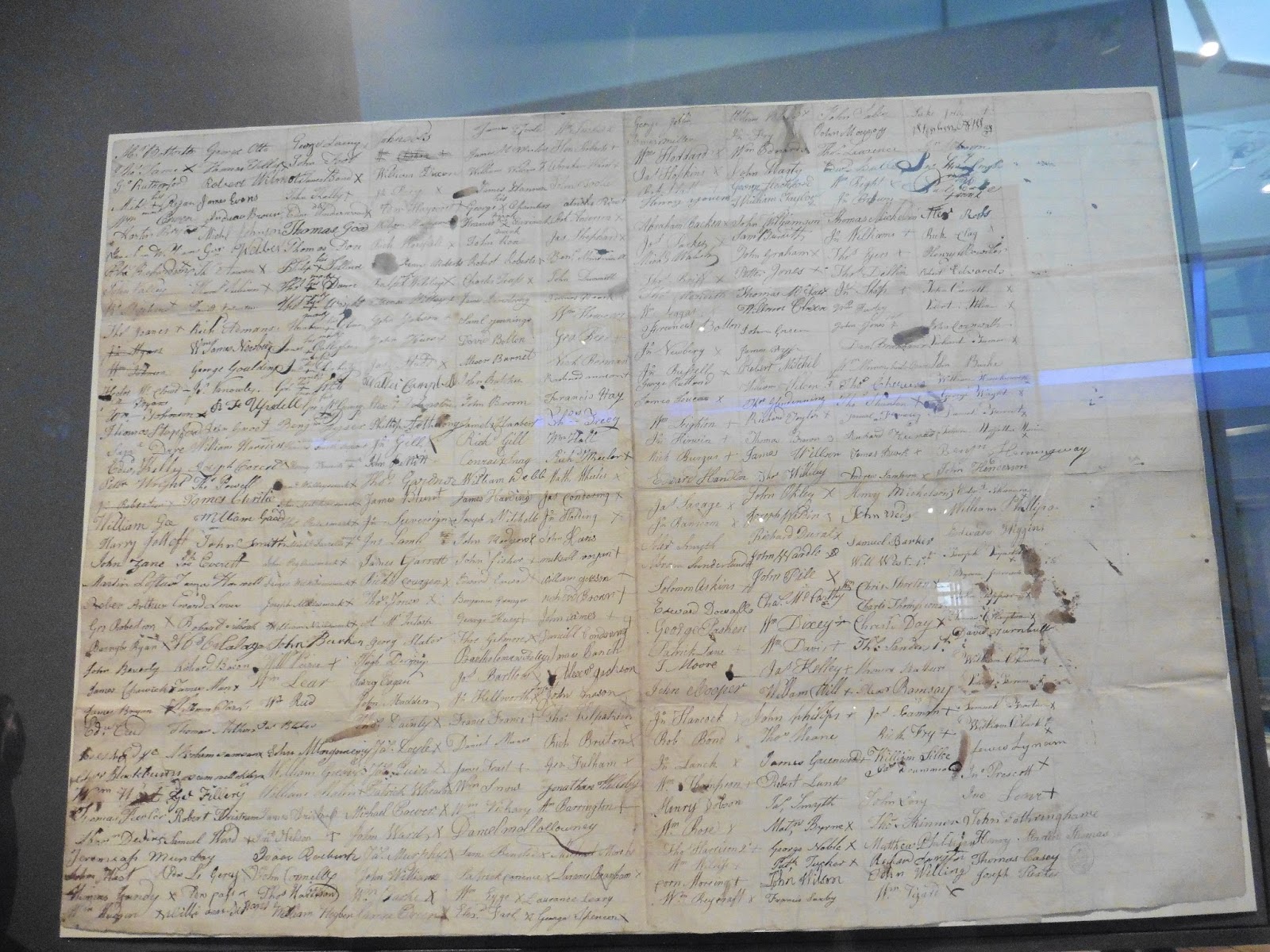
Apology from the crew of the Mars.
The strength of feeling amongst the men was so solid that parliament agreed to several of the men’s demands. They were given a substantial pay rise and offered a free pardon. By 23 April the mutiny appeared over, but trouble began agains when doubts surfaced over whether the promised pay rise would materialize. On 7 May the men of the London at Spithead mutinied and three officers were imprisoned; soon more ships mutinied at St Helens (a harbour on the Isle of Wight). The men were reassured by the Admiralty, and returned to their duties.
Richard Parker, mutineer.
Meanwhile on 12 May another mutiny broke out at the Nore (Sheerness), led by Richard Parker, a well-educated seaman from Exeter, who served on the Sandwich. The Nore mutineers wanted better wages, like the Spithead men, and additional demands such as a fairer distribution of prize-money (given when an enemy ship was taken). When news reached the Nore of the terms agreed at Spithead, the Admiralty believed that the men would back down.
But the Admiralty refused to give the extra concessions which the Nore mutineers wanted, so the seamen seized some gunboats in Sheerness harbour and fired at the fort there. Effigies of William Pitt and Lord Dundas were hanged at the yard-arm. The language used by many ships’ delegates was clearly modelled on Thomas Paine's works. The men talked of their rights and liberties, and the mutinous ships were dubbed the ‘Floating Republic’.
In late May, some ships from Admiral Duncan’s fleet joined the mutiny at the Nore instead of going to the Texel to blockade the French as ordered. This action in wartime greatly shocked public opinion, and lost the men much support.
During the first and second weeks of June, more and more ships slipped away from the rebel fleet and surrendered. By 14 June the mutiny was a spent force. Retribution was swift: Richard Parker and over twenty ringleaders were hanged at the yard-arm. You can watch a YouTube video about the mutinies here.
Images:
Seamen complain about their rations prior to the mutiny at the Nore. Cassell’s Illustrated History of England Vol. VI, (Cassell, Petter and Galpin, c.1864). Author’s collection.
Letter dated 25 June 1797 from the sailors on board the Mars, a 74-gunner, apologizing for the mutiny. On display at the National Maritime Museum, Greenwich (MKH/15.4).
A 1797 etching of Richard Parker, leader of the mutineers on the Nore. On display at the National Maritime Museum, Greenwich (PAH5441).


Wednesday, 2 March 2016

Ireland And Independence Part II: The United Irishmen


Ireland, 1813.

Ireland’s problems were exacerbated by social and religious tensions which regularly erupted into dreadful violence. For example, during the 1790s the Protestant and Presbyterian ‘Peep-O’-Day Boys’ attacked and burned the houses of Catholics in Armagh. To protect themselves, the Catholics formed armed associations known as the ‘Defenders’. After a terrific battle between the two factions at Diamond in Armagh in 1795, some Protestants formed the first Orange Lodge with the avowed intention of killing all Roman Catholics. 

But some Irishmen like Theobald Wolfe Tone, Samuel Neilson and others wanted to promote religious toleration, give the vote to disadvantaged Catholics, and push for an independent Ireland. Theobald Wolfe Tone (1763–1798) recalled that the thunderbolt of the French Revolution ‘changed in an instant the politics of Ireland…This oppressed, plundered, and insulted nation...sympathised most sincerely with the French people, and watched their progress to freedom’.
The Society of United Irishmen of Belfast was founded by Wolfe Tone and others in 1791. The Society promoted the works of Thomas Paine. The Belfast group was joined a few weeks later by another Society in Dublin, which had James Napper Tandy, a former Volunteer, as Secretary.

James Napper Tandy.

At this date the United Irishmen wanted peaceful, constitutional reform: universal manhood suffrage.  The Society’s mostly middle-class members included Catholics and Protestants; they tried to damp down the ongoing sectarian violence.
However, Ireland’s Roman Catholics were bitterly disappointed in 1793 when Pitt the Younger, under pressure from George III, shelved Catholic emancipation. Many Irishmen believed that civil war was now inevitable between the Protestant landowners and Catholic peasantry.
The Dublin government gave local magistrates sweeping powers to search for arms and disperse meetings. Militia regiments were embodied, public meetings were made illegal, societies like the United Irishmen were banned, and spies set to work.


Images:
Wolfe Tone and James Napper Tandy, courtesy Wikimedia Commons.


Map of Ireland. Barclay’s Dictionary, 1813. Author’s collection.

Wednesday, 3 February 2016

Radicals and Reform


Famous Radicals.

By the early 1790s, it was blindingly obvious to liberal-minded thinkers that Britain's corrupt electoral system was long overdue for reform. Unless you were a member of the governing elite, of course - the rich had inherited the earth, and their sons were destined to rule over the middle and lower classes.
The Radicals included some prominent Whigs like Charles James Fox and Sir Francis Burdett. They wanted the abolition of rotten boroughs, the introduction of annual parliaments, and a more representative franchise. Reformers harked back to the Magna Carta, the Bill of Rights and the Glorious Revolution of 1688, which they believed enshrined men’s civil liberties and rights. They looked back to a long-lost Saxon golden age in which all men had the vote. (On the other hand, the government asserted that there was no historical precedent for universal suffrage).
Major John Cartwright (1740–1824) was convinced that ‘many of the political evils of the day’ emanated from ‘ignorance of the principles of the constitution’.  This former naval officer, a neat, upright gentleman, had served with distinction until the American War of Independence, but resigned in disgust over what he perceived as Britain's unjust treatment of the colonists.
Charles James Fox.
Cartwright, a prolific writer and campaigner, believed that petitioning parliament was the only way to achieve radical reform. The Major was a founder member of the Society of Constitutional Information in 1780, along with John Horne Tooke and others. Even Pitt the Younger, then the great white hope of the reform movement, was a member – ironic considering his later treatment of the Radicals.
Thomas Paine.
In the 1790s, Thomas Paine’s revolutionary ideas were taken up by the Society of Constitutional Information and by the ‘corresponding societies’. These societies wrote to one another about parliamentary reform and the rights of man, and spread these ideas widely in Britain. One group, the United Englishmen, expressed the views of many freethinkers in its ‘Declaration, Resolutions and Constitution’: ‘The House of Commons...is now thoroughly corrupted, and from being the representative of a great and free People, is become a junto of Placemen, Pensioners and Court Dependents...The only effectual remedy...is a radical Reform of the Representation of the People in Parliament’ (PC/1/42/144, 1798).
Corresponding societies were formed in London, Manchester, Leeds,
Matthew Campbell Browne.
Nottingham, Norwich and Sheffield. The Sheffield Society for Constitutional Information had nearly two thousand members. The Society resolved that Paine should be thanked ‘for the affectionate concern he has shown in his second work on Behalf of the Poor, the Infant and the Aged; who notwithstanding the opulence which blesses other parts of the community, are by the grievous weight of Taxes, rendered the miserable victims of Poverty and wretchedness’. (Resolutions of the SSCI, 14 March 1792, Sheffield Archives, MD 251).
The government's spies kept close watch on the corresponding societies. Although most of the societies' members were peaceful, there were a select few with revolutionary intentions, as we shall see.
Images:

Noted Radicals: John Wilkes, John Horne Tooke, Sir Francis Burdett (5th Baronet), William Cobbett and Henry Hunt. History of England, Henry Fisher, Son, & Co., 1828. Author’s collection.

Charles James Fox, Dr Johnson’s Mrs Thrale, T.N. Foulis, 1910. Author’s collection.
‘Mad Tom, or the Man of Rights’. Courtesy Library of Congress, LC-USZ62-3847.
Citizen Matthew Campbell Browne, ‘Delegate from the Sheffield & Leeds Constitutional Societies to the British Convention’ at Edinburgh in 1794. Engraving by John Kay, 1794. Hugh Paton (ed.), A Series of Original Portraits and Caricature Etchings by the late John Kay, Vol. 2, (Adam and Charles Black, 1877). Author’s collection.